Featured

Education Can Save Your Life

A Previous Graduation Speech-Shared Again

Interesting Ideas

Below is the final graduation speech I gave to the Class of 2021. A recent visit to Newfoundland and a request from a previous staff member has pushed me to share it again. This is one portion of that speech.

Quotations are a very common device to use in a graduation speech and speech writers hope to have a saying, or a line that everyone will remember.  Maybe it is from a famous politician, or public figure, a philosopher or religious figure.  But the idea is to have something so simple, yet so profound that it gets repeated, and remembered long after the speech is done.  

So what would be my quote?  What will be my saying? What would I like attached to my name?  When students leave Boyne and they think of Mr. Marshall what is it I would want them to remember. 

I’m going to guess that you think it is this….

That is a pretty important quote. But, for this one special occasion you are incorrect.  I have a different quote to share with you.  The quote did not come from a famous politician, or public figure, a philosopher or religious figure. The quote I will share came from just a regular guy, just a regular everyday man, it came from my father. 

Education can save your life.  

Now, having said about looking to the future, and graduation is all about the future, I am going to go back. and back to the year 2001

In the same year, 2001 that the book was written, another document was written.  But I did not receive it in 2001, I didn’t receive it until 4 years later.  After my father passed away. In 2005 my family found a document he had written.  The document was written in 2001.
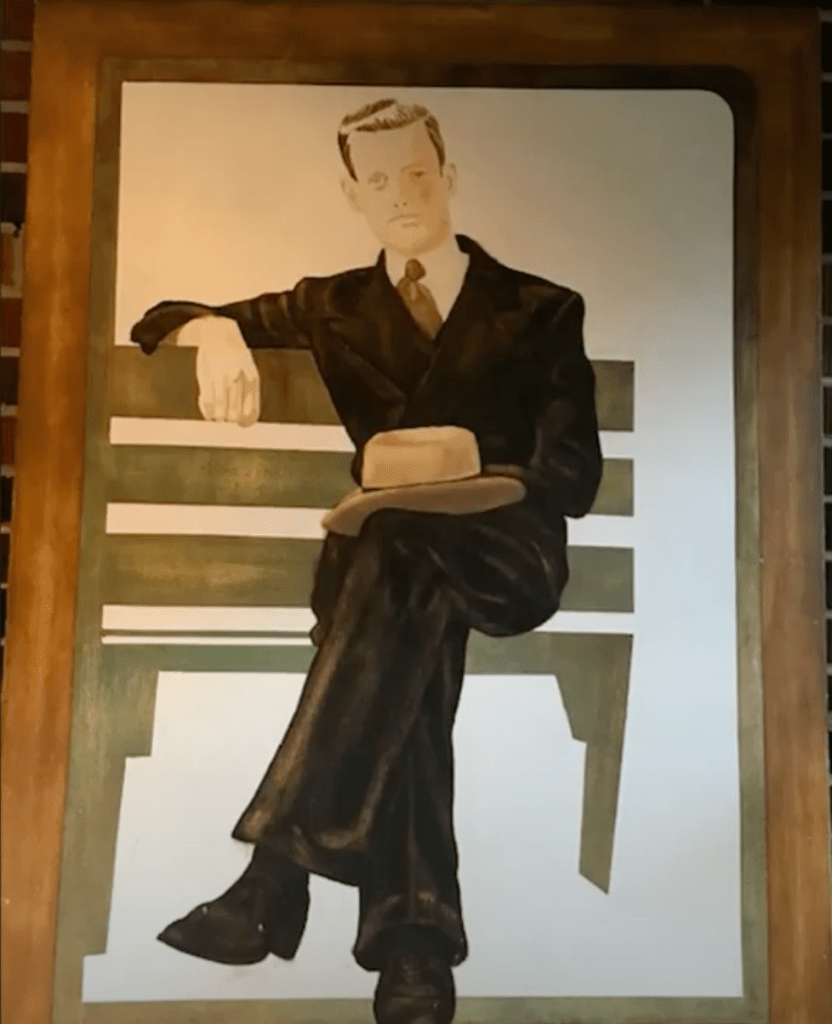
Painting of my Father

The art work that was hanging behind me at the beginning of this talk is a painting of my father.  This painting has been hanging in every office that I have worked in since becoming an administrator in that same year, 2001.  If you have ever visited me in the office area you would have seen this hanging out with me each and every day. 

.

.

.

My Father Looking Sharp

His writing was about how his potential, was put on hold.  After finishing high school, and beginning his life as a young man, his life was put on hold because of the second world war.  Sometimes things happen, and we have to pause, we cannot go forward.

He didn’t talk much about the war, he was great at changing the subject if any of my brothers and sisters or myself brought it up.  He was a pacifist, he believed in peace, he was a real gentle man. There were events and situations from his time in the war, that he would just not share with any of us.

In 2001 he sat down and wrote out his story. He titled it: I Remember
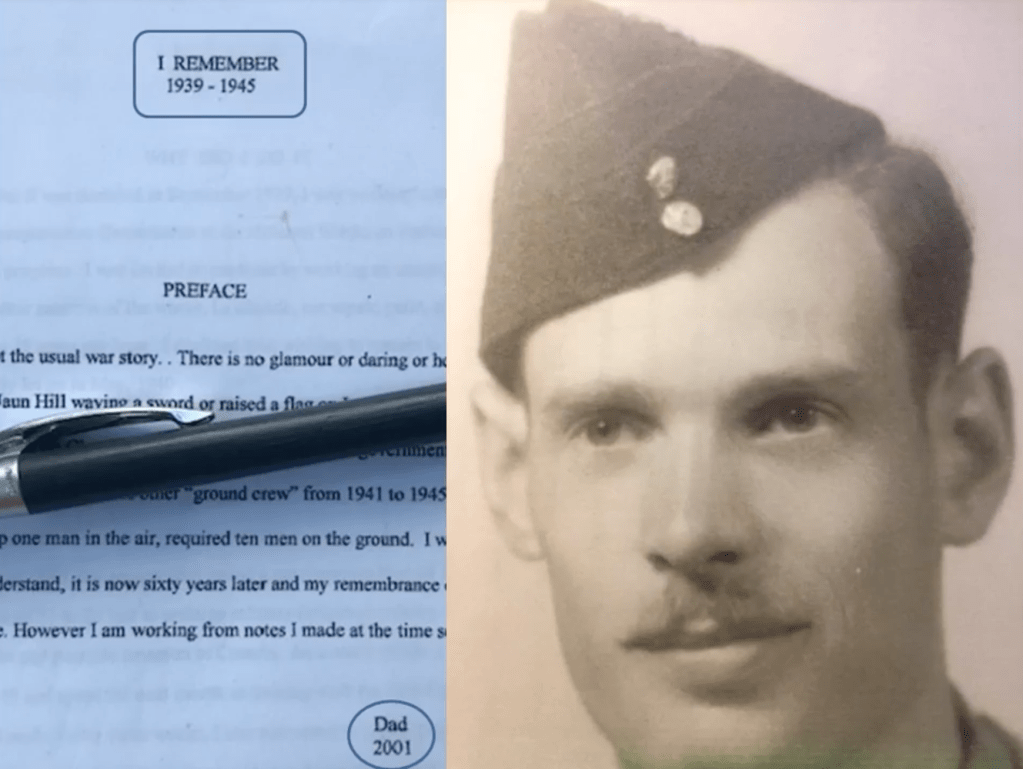
In his very first lines, he has written. “this is not the usual war story.  There is no glamour or daring or heroism”. And that sentence really does describe my father.

As a young man a world event occurred that changed his path in life, it was an event that changed the course of history.

Education Can Save Your Life

And throughout his writing, he comments: Education can save your life.  On those nights I wanted to go and be with my friends and not do my homework or attend to my studies, my father would share with me the value of an education.

My father earned his high school degree and studied a trade.  He became a carpenter, and he believed that by having this education it saved his life during the war. By finishing his schooling at the time, and developing a skill and a trade, it saved him from the horrors of war.

Once out of school he obtained work at deHaviland aircraft, as a joiner, the British term for woodworker/carpenter, building the wings for the plane the Tiger Moth  

He was paid 75 cents per hour and he felt like a rich man.  He was happy, he was using his education, doing what he loved and earning money.

In 1939, Canada joined the Second World War.  And In August of 1940, the government issued a proclamation that all unmarried men between the ages of 21 and 25 had to undergo military training, in particular infantry training in preparation for any possible invasion of Canada

Globe and Mail Newspaper Headline

https://www.theglobeandmail.com/community/sept-10-1939-canada-declares-war/article14213144/

At this same time De Haviland Aircraft also started making the Avro Anson, and they needed my father for his skills.  Since he was a worker with an education in a wartime industry, he was exempt from military service.

He said: Education Can Save Your Life

Seeing some of his friends and neighbours go off to be in the infantry and leave the country, with their futures unknown, my father took his education and training and enlisted in the Royal Canadian Air Force.  He shares that even though he could be exempt from military service and stay close to home working in a factory building planes, the patriotic climate at the time convinced him that he should volunteer and see where the Air Force could use him.

He was part of the war effort, but his education kept him working and contributing without being shipped overseas or put in a combat role.

He did share that some of his friends from high school, those without a trade or training were not so fortunate, and he did not see them again.

Education Can Save Your Life

If an aircraft was damaged at the station, a crew was sent to repair it on site.  If however the crash occurred off station, a salvage crew was sent out to bring it back where it was assessed as repairable or was written off.

My father spent 1941-1945 as part of the ground crew.  There was a rule of thumb that to keep one man in the air, required ten men on the ground.  My father was one of those ten.

Throughout his paper he continually returns to the comments about education saving his life, but there are lighter moments.

His co-worker and best buddy was nicknamed Tubby, (the men obviously were not so kind in their choices of nicknames) and one day Tubby and my father were sent out to make some modifications to the Norseman float planes.  The Air Force wanted cameras attached to the bottom of the fuselage in order to capture Aerial Views of enemy territory.

From his papers he had written about this major contribution to the war effort, “It was a hot, sunny day and as we were entirely on our own, we soon discarded overalls and any vestiges of uniform and worked in our shorts.  The water where the plane was tethered was about six feet deep and very inviting.  We found that for some unknown reason our tools had the habit of slipping out of our hands and as we could not allow government property to be lost, we had to dive down to retrieve them.  A most refreshing day!’

Early in 1944 my father was told to report to the Overseas Posting Depot, and he thought, I’m finally going to England.  His education was needed. And it was needed…

…in  Gander Newfoundland.  As Newfoundland would not become a province of Canada until after the war in 1949, it was outside of Canada and considered to be overseas.

Gander was an important airport.  As a final stop before travelling over the Atlantic Ocean it was a busy place.  It also was the place where returning planes brought back the Canadians that had lost their lives, or were severely injured.  Once again, my father spends time in this section sharing how fortunate he feels for having an education, being able to do his trade and remaining closer to home instead of in the front lines of battle, like so many other young people.

Education Can Save Your Life

Gander Newfoundland’s Airport will become famous again long after the war.  The year, 2001.  The same year of the book I shared, the same year that my father wrote his memours, the same year I began my administrative career. In 2001, September 11th occurred.  It was the airport in Gander Newfoundland that accommodated all the air travel that needed to be grounded that day.  September 11, 2001, another day that changed the course of history.  My father was so proud that his home in Gander was able to make this contribution.

You may know of the stage show, Come From Away that tells the story of Gander Newfoundland and how the community rose to prominence in their support of people impacted by 9-11. A small town that welcomed the world.

It was in Gander, that my father started to do repairs on the Hudson and Lancaster Bombers.  

When my children were little they would stop and point to one of the last remaining flying Lancasters, kept at the Hamilton Warplane Museum.  The Lancaster sounds different when it flies, and you can hear it coming.  Where we live in Burlington, it flies over many times each year and my children would stop and point and say ‘Papa’s Plane’
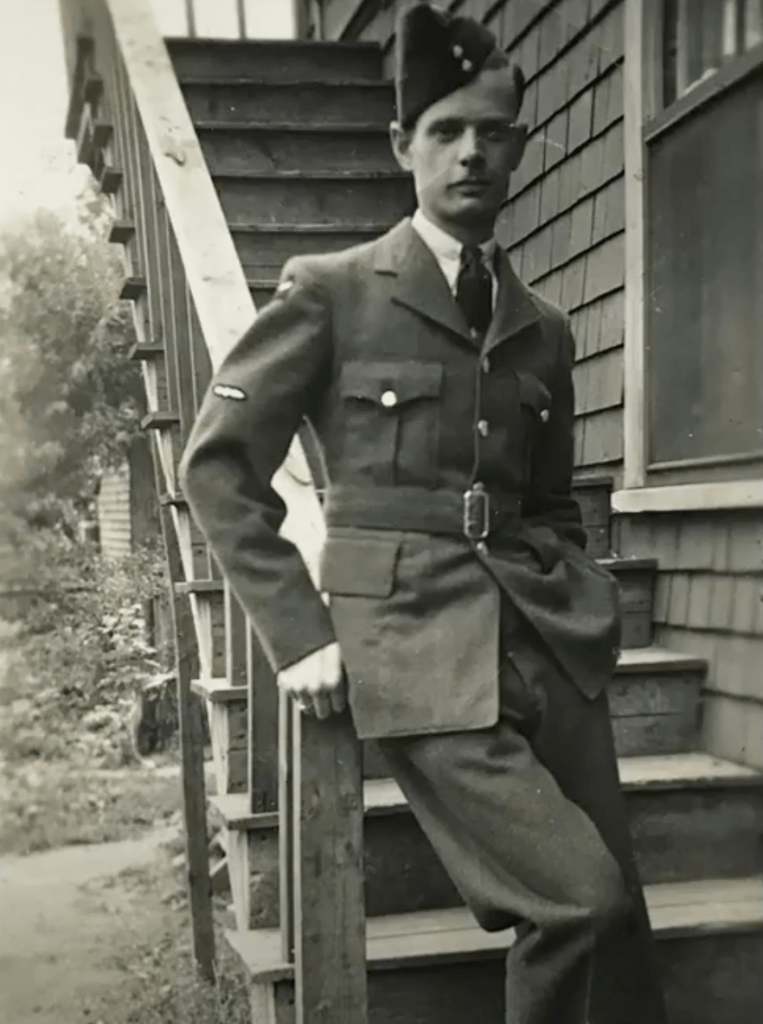
Father Back Home on a Visit

So why share his war story?

Why share the story of my father?

It is because of the quote, education can save your life.

I chose public education for a reason. Our school is a reflection of our community, it is a place that welcomes all, all the best things about the Milton Community are inside of Boyne.  But as a public school, we do have all parts of the community, the good and the bad, the happy and the sad, and we support and love you all

.

.

My fathers story connects to two life changing events, WW2 and 9-11, and this year, we have all experienced numerous life changing events.  You will never forget that you are a graduating class, in 2021 when our graduation needed to be done on line.  

This year, I have never felt so strong in my belief that education can save your life.  The events of this year have shown as all the importance of education.  

The events of this year have shown us all that we need well rounded children moving into the future.  

Children that are bright, intelligent, but more importantly young adults that are tolerant, compassionate and loving.

I know this is not how you wanted to celebrate your graduation but that doesn’t make your accomplishment smaller or any less significant.  You have potential, and the whole world to explore and make better.  Right now it probably feels like the world is pretty small, we have all needed to stay very close to home, but the world will grow again.  Just like you have. Just like we all have.

We need all of you for our future, it has been a tough year, but education is going to get us through it.  

We need the educated to make the world a better place and it begins with you.
Featured

Building Your Classes for Next Year

Interesting Ideas

An Interesting Idea came to me when we were beginning our new school. Originally I thought we would only need this process in the first couple of years, but I was incorrect.  We ended up repeating this procedure each year around this time as a ‘way we do things around here’ .  The response from staff was so strong and the results of the process were so successful that we continued the tradition from that day forward.  It does take some time but like many things in our schools, we can give it the attention it deserves when you first do it or you end up having to spend way more time with it later when you are trying to repair it.  

I wanted to share this Interesting Idea with you today. 

At about this time, schools in Ontario are winding down the year and you are beginning preparations for a new school year to start in September.  One of the big tasks that is done at this time is creating the classes of students for the following year.

Prior to coming to the school I had been an administrator in four others schools and had seen lots of examples of how this process was done.  Going to a new school I had seen the process that was in place and I’m sorry to say that in some cases I left the meeting feeling awful about what I had just witnessed and been a part of.

Teachers were coming to the meeting with predetermined ideas of where students should be placed the following year.

Teachers were coming and making sure their colleagues in the next grade got particular students in their classes

Unprofessional comments were made about students and what kind of year they had had

The use of deficit language to describe the skills and abilities of students and even the ranking and listing of students from struggling to highly able was done in order to sift and sort.

The entire process was done in one session, with names on post it notes and teachers just placing them on posters with little or no discussion.

It was not going to be this way.  We were going to take our time, we were going to get lots of information ‘on the table’ and we were going to involve many stakeholders.

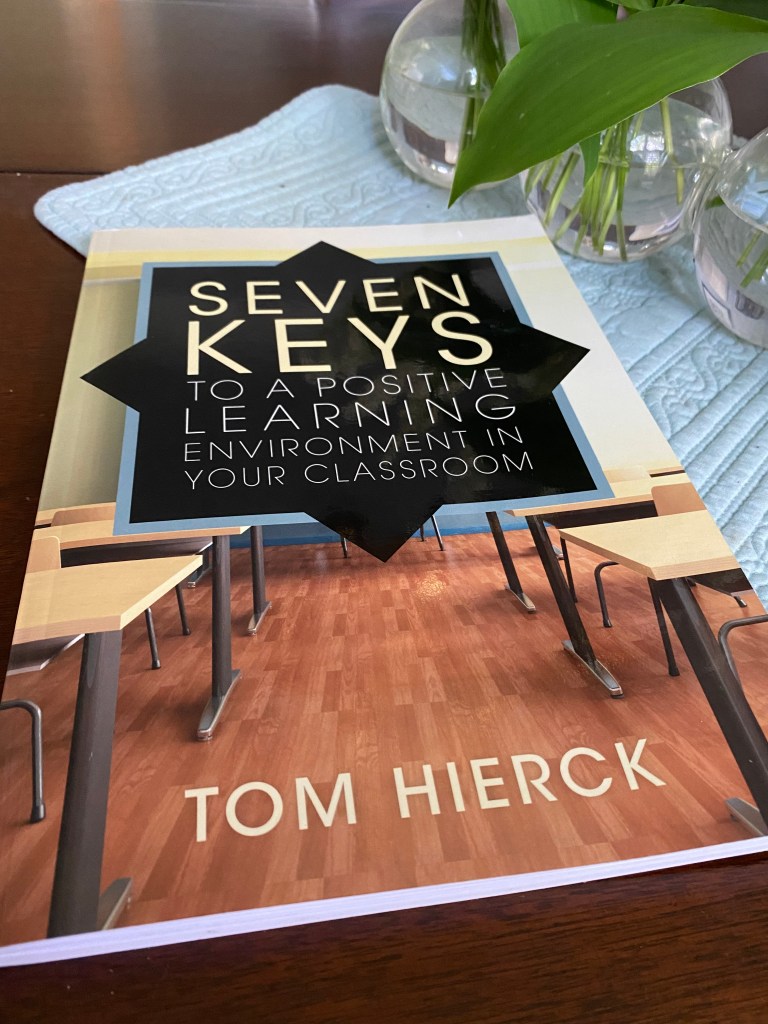
Tom Hierck's Seven Keys To a Positive Learning Environment in Your Classroom
Tom Hierck’s Seven Keys To a Positive Learning Environment in Your Classroom

In Tom Hierck’s book, Seven Keys To a Positive Learning Environment in Your Classroom he comments,

‘Establishing positive learning environments-collaboratively created, systemically sustained-is focused, powerful work that every school should consider’ (p.1)

Hierck, T. (2017). Seven Keys To a Positive Learning Environment in Your Classroom

We were going to do our class building, one grade at a time in a process that respected and utilized the following keys:

Common expectations

Collaborative teams

Data-driven dialogue

School wide approach

As a school we shared the process and the proper use of language.  We were going to speak about students from a strengths and needs standpoint.  After all, in our school we honoured our posters that said, ’positive comments spoken here’.

Positive Comments Poster

We were all reminded that each child is someone’s child and we were going to discuss their DNA (desires, needs, assets)

“ When teachers and learners work together, they can isolate the individual’s learning DNA…Such data are invaluable in the teaching and learning process’(p. 41)

Hierck, T. (2017). Seven Keys To a Positive Learning Environment in Your Classroom

We asked teachers to fill out cards on each student.  These cards could be manipulated on the table top and grouped so we could all see.  After names were recorded that data could be given to the receiving teachers.  The information on the card included important school wide data we were tracking as well as some learning skills (behaviour skills such as organization, self regulation, problem solving).  There would be a section for friends that the students should have in their class as well as a section to suggest partnerships that should be prevented and of course a section titled “DNA”.

Many teachers had asked students for their involvement by having a discussion during class meetings about peers that were helpful to them and friends that would distract them from their learning.  Students were invited to list some peers and teachers brought these notes with them.  Of course this was done in a kind and caring manner and our teachers’ professional judgment was hugely important for final decisions.  However, as a school we felt we needed some student voice.

One of the best outcomes of this entire process became apparent in September. When teachers were building relationships with students during Significant 72 the DNA section provided really important information about each child.

Since we were following a school wide approach, we standardized the class building process, and repeated it each after school for a different grade.  We did one grade a night, so a grade two teacher was asked to attend twice, once as a giver (grade 2 to grade 3 building) and once as a receiver (grade 1 to grade 2 building) if they were remaining in the same grade.  Of course, snacks were provided and lots of up front work was done.

To assist with all the work and philosophy around our RTI program (we called it WIN-Whatever I Need) we asked staff to consider instructional groupings as they came in with their information. As a teacher, which students could be grouped with similar strengths and needs in literacy first, and then looking at mathematics.  If the social dynamics were fine, a receiving teacher would receive an entire group of students with similar educational needs.  Along a continuum, you would have students that were below, at and above grade level in each class but within those categories you would have clusters.

This Interesting Idea was really helpful for our combined grade classes.  You may have two grades in your classroom for next year but you will be able to manage better because of the instructional groupings that are made within those two grades.

The final aspect of our class building that I consider an Interesting Idea was how we used the ‘receiving teachers’.  They were not simply spectators to the entire process but instead they were integral to beginning the entire process.  You see in the first few years of the school we were growing and new staff were coming in each year as we added class after class.  Our staff did not know each other.  How can you send off a child into the following year to a teacher you know nothing about?

The receiving teachers would each take a turn to introduce themselves to others and share a glimpse inside their classroom.  As the educators listened to the story of our newcomer teachers you could see them moving and shuffling the cards in front of them in order to optimize the educator for the learning needs of the students.

I would speak to the receiving teachers ahead of time so they knew that this was coming.  They did have time to think about it.  It was not a job interview, they already had the job and we were happy to have them! 

We did this every year even for those teachers that had been at this school since the start.  Every ‘giving’ teacher was able to see inside the classroom of the ‘receiving’ teachers.

We suggested they comment on things like:

Do you prefer a noisy, active classroom or a quiet classroom?

Describe their literacy program, their math program?

How do they like to have their timetable?

Which subject areas are they most passionate about teaching?

How do they start their day?

When do they schedule aspects of the day such as arts, drama etc?

Which students seem to really thrive in their classroom?

Which students do they love to work with?

How do they like to communicate with families?

Face it, we think we know how our colleagues teach, and maybe you are lucky to team teach and really get a picture of others. But how often do you get opportunities to go into each others’ classrooms?  In reality the classroom down the hall from you can be a mystery and you are about to collaborate with others and make decisions about where students will be the following year.

You may really like the teacher as a person, as a friend, but are they the right teacher for the student?

One of the hiring questions I asked myself all the time was not, ‘’who is the best teacher from those that I have interviewed’, but instead, ‘who is the best teacher for the students that they will have in front of them’ it is a slightly different question, but an extremely important one.  The context of your school and the DNA of your students is a key factor in making the proper decisions for students.  This Interesting Idea is a potential way to slow down this important decision, build staff trust and cooperation, and set each classroom up for success in the following year.

Featured

Record Holders

Create Your Own School Book of Records

Interesting Idea

Each year around this time we would run an annual event to bring some joy and enthusiasm into our school.  Coming out of winter and heading into spring, we all needed a boost of positive school energy.

The Book of Records!

We would involve our intermediate students, grade 7 & 8, in a series of events showcasing their talents while trying to make a name for themselves that would live on past their graduation date.

The first time I shared this idea with the school I borrowed a copy of the Guinness Book of World Records from the library and brought it to an assembly.  I would ask our teacher librarian for some data because It was always one of our most popular books.  The current edition was always in the Top Ten of borrowed books and when students came into the library to chill, read or relax, students often asked for this book.  When we had book sales at the school it was always a popular purchase.  The students knew this book! 

I explained that I knew “of” some of the people in the book but I didn’t “know” the people in the book. We were going to start our own Book of Records.  The Boyne Book of Records.  Inside this book, we would know the people that were highlighted.  As long as their record stood, they would have a page dedicated to them.

I created a book in every school where I was an administrator: the Pilgrim Wood Book of Records, a Heritage Glen Book of Records, a Pineland Book of Records and a Tecumseh Book of Records. 

The events in the book were suggested by the students and many of them were ones I had done in all the other schools.  As I went from school to school I was able to share what was in the other books.  The event needed to be standardized so it could be repeated the same way each year.  It needed to be something that could be measured, or counted.  They all had to be safe, and we did not have any eating contests or activities that presented a risk to students.

For example, students wanted to have a floor hockey shoot out against a goalie, where you could see how many goals you could score out of 10, or consecutively.  They soon realized that this could not be repeated in future years because it required the use of a goalie and I was not going to play net during this event!  So they came up with consecutive goals shooting at an empty net the length of the gymnasium.  This could be repeated the same way each year.  We created a book of rules, explaining the number of attempts or which painted lines in the gym were used to show a start line or boundary.  This way it could be repeated exactly the same way in the following year.

Activities included:

  • with a partner, consecutive badminton passes over the net
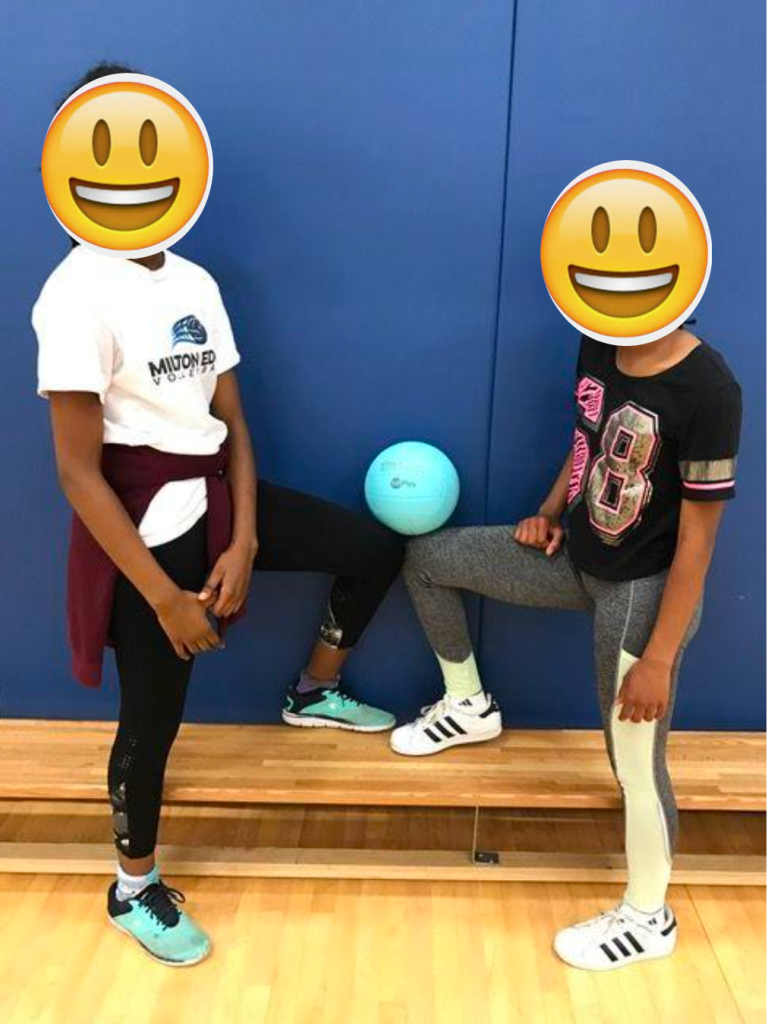
  • With a partner, consecutive volleyball passes over the net
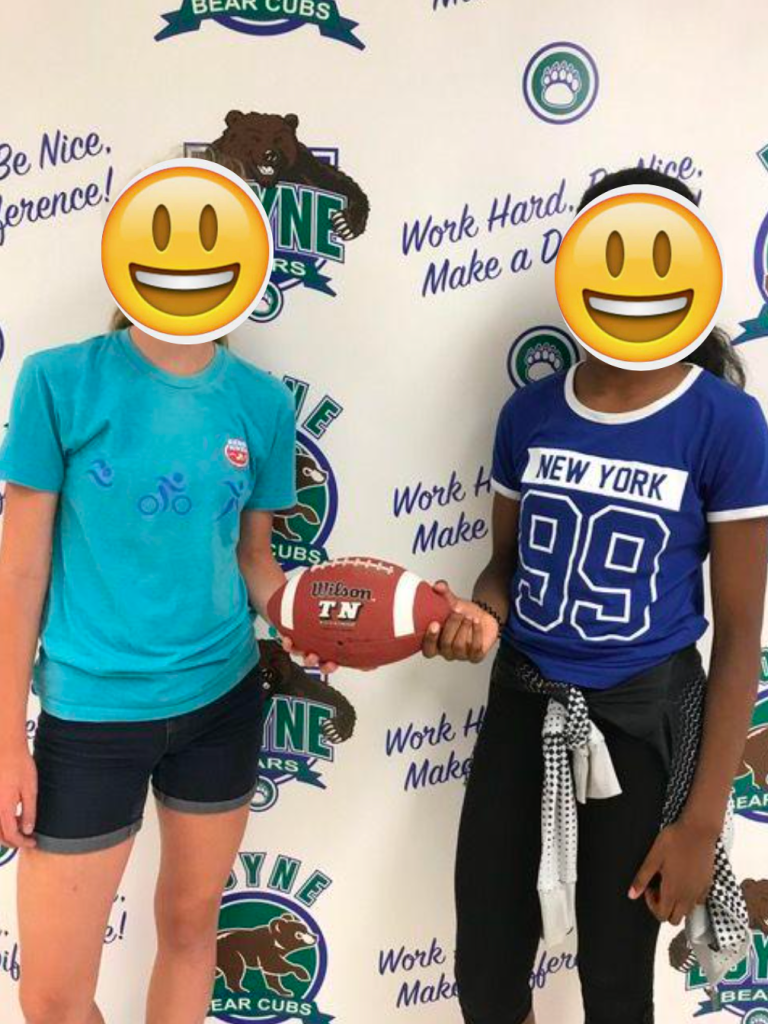
  • With a partner, consecutive catches of a football, the length of the gym
  • With a partner, consecutive frisbee catches, the length of the gym
  • Consecutive hockey goals shooting the length of the gym
  • Consecutive soccer goals shooting the length of the gym
  • How long can you skip rope
  • How long you can hula hoop
  • How long you can keep two hula hoops rotating around your outstretched arms
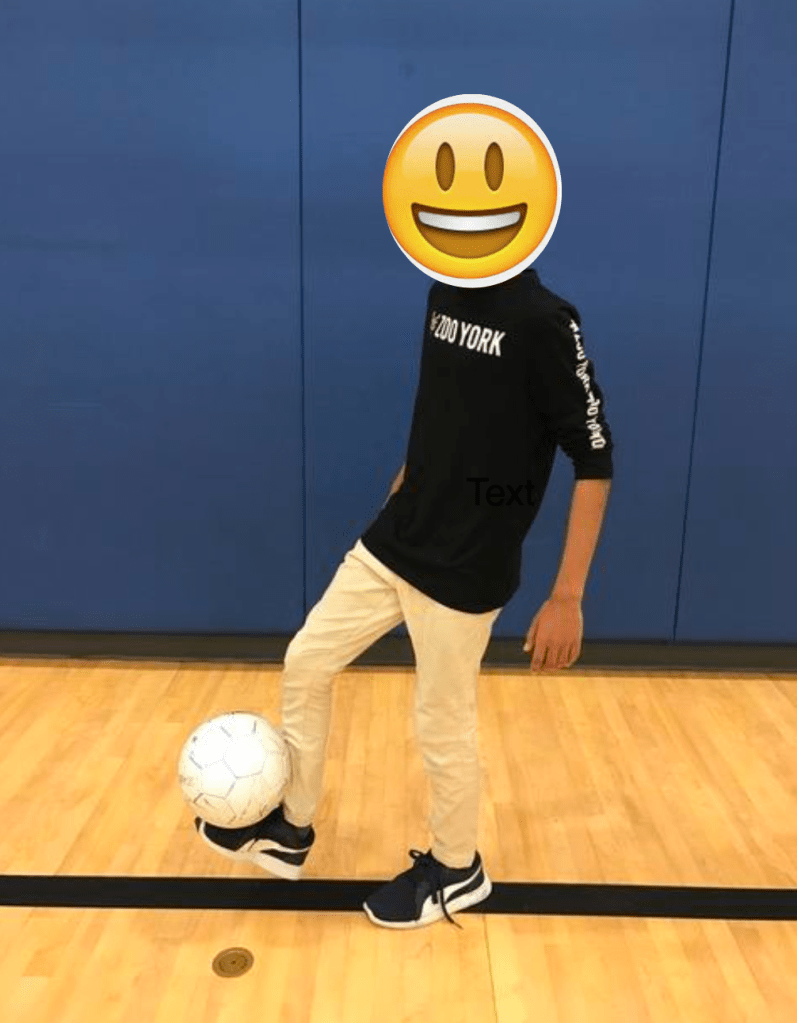
  • Keeping a soccer ball up off the ground, consecutive touches
  • Free Throws in Basketball, how many in a row
  • 3 Pointers in Basketball
Volleyball Record Holders

We would select one day and have a large assembly to see if anyone could break an existing record.  We included a few younger grades as spectators because they could participate the following year.  

On that day the students would try to beat the record in the book and have their name and photograph entered.  The book was placed in the library and students could look at this book as well as the Guinness Book of Records!  They knew the people in this book.

During the assembly we could have two or three events occurring at the same time in different areas of the gym (three ring circus) and often the crowd of students would have to be moved from one area to another depending on the equipment and area needed.  The events that took a long time needed to start early in the day so we would not run out of time before dismissal.  We found we got better each year running the final event because of what we had learned in previous years.

For a few weeks prior to the assembly we would have open gym periods during the break times and students could come down and try their hand at the different events.  We would do a different event each day. We would record scores and have the top three identified. These students would do the event again during the assembly in front of their classmates.  On the big event day we only had three students or teams try to beat the record, however, prior to this we would have the gym full of students trying to make it to the final three.  Huge school participation.

So the scores during the ‘tryouts’ did not count in the record book only the result they achieved on the day of the event.  Inside the front cover of the Record Book we had a paragraph explaining the process and then the date each year that the event took place.

One of the lovely outcomes, and at first I was concerned, was that students proved me wrong with their enthusiasm and support for the students that were doing the events.  It was explained that they all received the three highest scores during a trial and today they would be having a shot at the record.  Some students would not have a great day but still they were supported by their classmates.  Regardless of result students were cheered, received high fives and given a special memory.

Football Record Holders

I found it best not to share the current record ahead of time.  Many in the crowd knew the records because the book had been in the library and they knew some of the records or looked them up when they or a friend were in the final event.  I learned it was best to remove the book from the library as we began the lead up to the event.

In the first year it was amazing because every ‘winner’ of an event at the assembly got into the record book. In my final year I think only one record was broken, but the enthusiasm to try to get into the book was huge.  Over time it will be more difficult to get into the book which just makes it an even more special accomplishment.

Staff came and assisted with the record book assembly as timers and crowd control but I always gave the option that staff could be free and working on reports at this time.  As long as they worked in teams and had some of the staff in the gym with me I was fine with them getting this extra time which was always appreciated.  

Inside the Record Book we would dedicate an entire page to the activity. 

Student Record Holder

It would include a description of the event, the record result and a photograph of the student or pair of students.

There you have it, another Interesting Idea that will build school culture and have your students buzzing with excitement.

Featured

Ed, the Superstar!

Interesting Idea

As the leader in your school do you know everyone’s name?  Do they all know you?  We have all experienced that frightening feeling when you are out and someone comes up to you (in my case, very much younger) and says, “Do you remember me? You were my teacher/principal.”

Who is the most popular at your school?  Is there anyone that you could say without doubt that every child, every staff member and even most of the parents know by name?

In our case, it was Ed!

Ed !

When I was tweeting the 30 Things I Will Miss About Being a Principal I placed Ed at #10 on my list of things I will miss when retired.  Ed made my top ten!  

That particular tweet generated quite a few responses from staff at the school.

From someone who had moved onto another school, ‘I miss Ed’.

Another knew Ed from a previous school and tweeted, “I had ‘Ed duty’ at EFT, carried him outside with me every Friday for a year…all the while thinking he was a turtle.”

Another shared how, “Ed works so hard to make a difference for the community at Boyne that he often deserves some much needed R&R and extra special vacation time” with a photograph of Ed in a store surrounded by wine and 5 staff members on a Friday night on their way to a weekend retreat.

And the simple, ‘I love Ed’ or ‘Ed is the best!’

So who is Ed?  

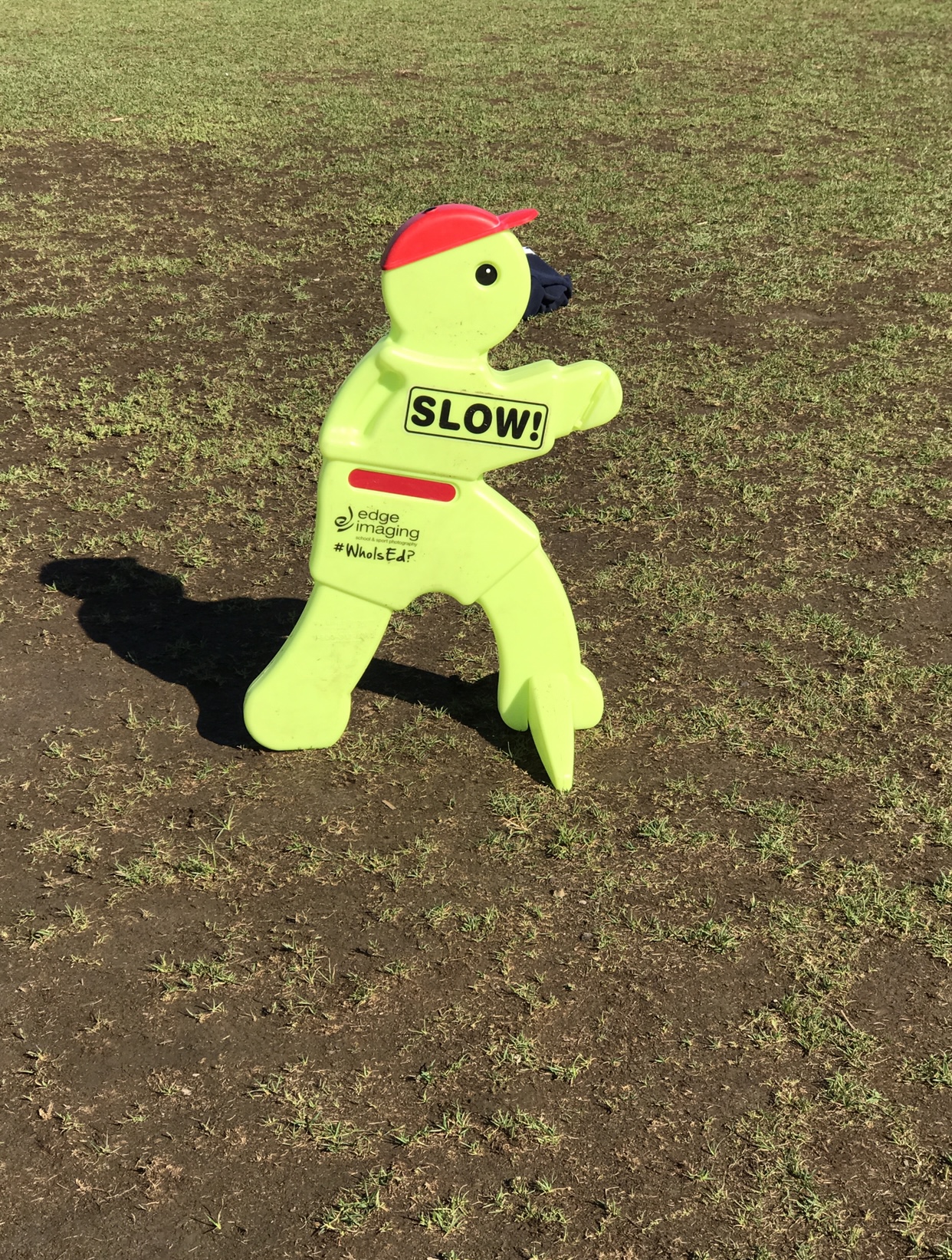
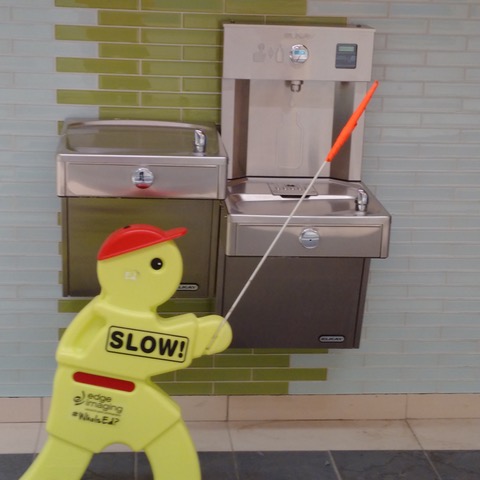
Ed was the universal name given to six different large plastic ‘people’.

Ed was a gift from the photography company we had a contract with, Edge Imaging.  ‘Ed’ was used as a visual symbol every day to signal where we could safely and comfortably be playing when outside during breaks and recess time.

If Ed was on a field, you could go on that field.  Ed was the first to go on the field to show everyone that it was okay to join him.  No Ed on the field, meant that field was ‘out of bounds’ for the break time.

This was all done originally to protect instructional time.  I had been in too many schools as a staff member and as an administrator where the public address system was being used to tell staff and students that the fields were closed.  Or that bad weather would mean we would have to stay off the grassy areas.  We could only use the pavement areas of the school.  

And you know when this announcement is made, right?  It is broadcast with a few minutes to go in class, just as staff are working hard to get instructions completed, or assessments done because we were about to go on a break. The entire school interrupted, learning stopped, so we could announce our areas of play outside.

Right now, count the number of interruptions that someone using your PA system makes during instructional time in any given week.  Our school was going to be different. We were not going to interrupt important instructional time with an announcement that could be provided in another way.  Ed was our way of sharing that information.

When we first opened the school, we had our Eds ready to go but didn’t use them right away.  Our fields were closed when we first opened, and large construction fences blocked entry to the grassy areas.  Since we could not use the fields and were restricted to the pavement, this was the perfect time to get our expectations in place prior to the fields being available to us.

Each day we would take a photograph of ‘Ed’ somewhere inside the school.  Since it was a brand new school we would ask students on the morning announcements ‘Where’s Ed?’  And they would have to work with our staff to figure out where Ed was hiding based on the clues in the picture.  We also placed a few ‘Ed’s’ around the school so students would see exactly what Ed looked like up close and personal. 

Ed Hiding By the Water Fountain

Another way we protected instructional time was in regards to announcements.  All the announcements were created on a shared document that every staff member could access and view with their classes when they wished to do so.  We did not start the day with announcements over the loud speaker, which often contained news of the day that was not applicable to many of the ages and grades in our school.  Each individual classroom was responsible for how and when they would share announcements. More on how we did announcements can be found in this previous blog.

After a couple of weeks playing  ‘Where’s Ed’ we had an assembly to announce that the fences were coming down and we could use the field.  An Ed was in the assembly tucked in the corner and I asked from the front of the assembled mass of students, ’Where’s Ed?’  By this point Ed had become a Rockstar. Hundreds of students yelled out as they pointed to Ed standing guard in the corner.  Ed was moved to front and centre and we explained who Ed was, what Ed’s job was for our school and that students need to continue to look for Ed each and every day at school.  But from now on Ed was going to live outside.

Some of the creative writing that took place was out of this world.  Ed at Night.  Ed on the Weekend.  Ed During Holidays.

Ed did have an adventurous life.  Staff felt that it would be hilarious to continue the Where is Ed as an adults only game.  Remember we had about 6 of them.  Ed would be taken on weekends and holiday trips, photographed having all kinds of fun (better weekends than most of mine!) And the pictures would make their way around the staff portals on the following Monday.  Lucky Ed!  You know your staff are buying in and loving the culture that is being developed when they continue a school tradition in this way.  All done in good taste and continuing to build our staff morale.

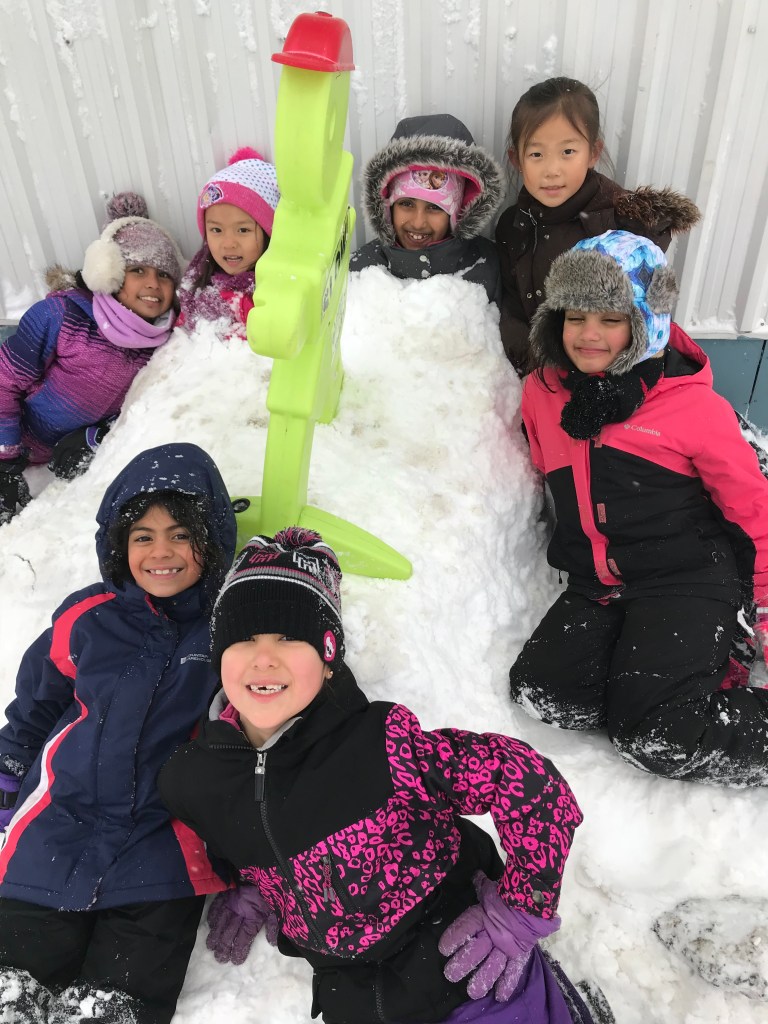
Ed Playing in the Snow with Students

Each day, right before break time, because weather can change in Canada from first thing in the morning until the timing of our first recess, one of the admin would go out and place Ed on the fields that were accessible that break.  Students went outside and saw where they could go.  Class learning time was not interrupted.  Staff outside on supervision also knew and could reinforce with students where they could play based on the presence of Ed.  Staff would even look out the window and see Ed on the field meaning we were going outside.  No more calls down to the office to find out if we were going outside or staying inside.  “We always go outside, unless you hear different.”

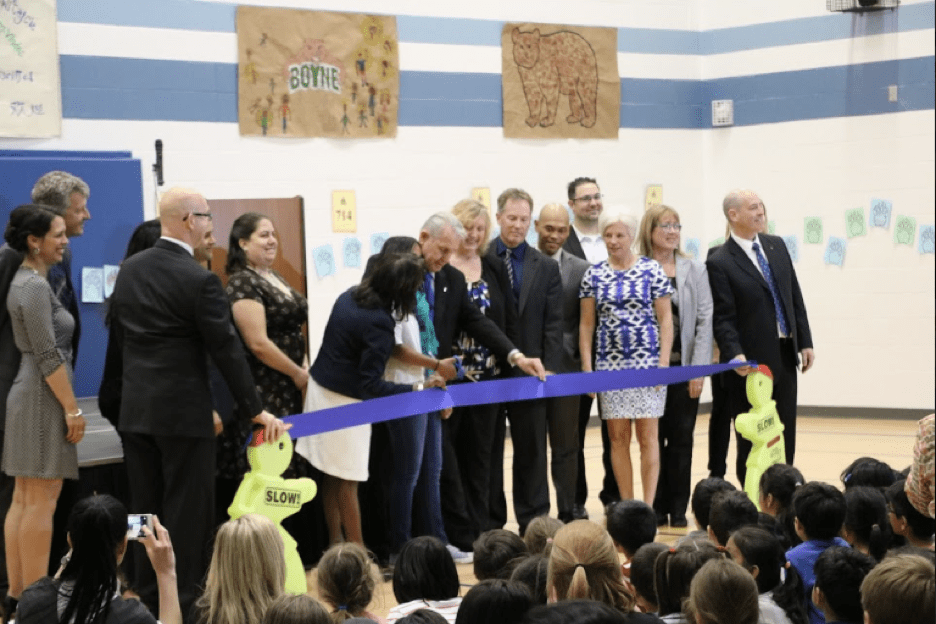
Ed was so popular we knew we had to find a way to include Ed in the official school opening.  During our large official school opening ceremony with politicians, education leaders, architects and builders in attendance Ed was involved as well.  At the time of the official ribbon cutting and the official photo opportunity, Ed was there!   Two Ed’s held the ribbon that was being cut by our dignitaries.  

Official Ribbon Cutting With ED!

Every child got a piece of the official school opening ribbon.  We bought lots of extra ribbon and had it cut into small squares.  Every child received this keepsake.  I still have mine.  

And I made sure that my piece was from the section held by our two Ed’s.

Ed was also a popular Halloween costume!

Ed as Costumes

There’s the Interesting Idea!  How can you preserve instructional time by preventing interruptions?  How can you share important information in a visual format so staff and students know what should be happening?  Find flags, find numbers or symbols.  Find Eds if you are able, but find a way to honour instructional time.  Stop interrupting learning.

Featured

The Newcomer Has A Plan

Interesting Idea

I have returned to a school for the past three weeks as an occasional principal during an absence of a colleague.  It is a wonderful school with lots of amazing things happening for students. 

The ratio of technology to students is very high.  Every classroom is well equipped to provide technology for student use.  This school would certainly check off a lot of the boxes for the qualities that make for an effective school.

One particular ‘next step’ did stand out however, and I wanted to address it during my time.  After week number two I knew I needed to stick my neck out a little and have a conversation with staff and students about the use of cell phones.  Very few students could tell me the school expectations in regards to cell phone use.  Instructional time was not being used optimally and the potential for student online behaviour concerns was imminent. There were inconsistencies between classes, students were sneaking into washrooms to use their phones, and parents were texting students in the middle of classes instead of calling into the main office.  Sadly, during break times, both inside and outside, the students were having online conversations with others instead of face to face interactions with their classmates.  After being on screens for the last few years, and slowly having our restrictions lifted it was a shame to see students not interacting with each other like in the ‘good old days’.

Knowing that I was going to be at the school for only a short amount of time, I laid out a plan with the absent administrator as well as the vice principals in the school and collectively we decided to move forward.  

I knew time would not allow me to have focus groups with students.  I would not be able to gather student voice by poll or survey.  Instead we were just going to adopt a policy and then review after my departure.  We all felt that the ‘visitor’ to the school could share his observations and the plan going forward.

So this past week I visited all the grade 6, grade 7, and grade 8 classrooms and shared with them what was going to happen during the month of March.  I shared that a focus group would not work in this case and that we wanted their involvement at the end of the month.  They were reminded that there is a Spring Break!  I also shared that my belief was that no student could debate with me that cell phones were being used properly by all students in the school.  They had witnessed it themselves, and knew that there must be common agreements when it came to cell phone use in schools.

Teachers have been, or will be working on persuasive writing and using this cell phone/technology plan as a real life example the students and staff will come up with a long term plan after I leave.

Below is an original blog from November 8, 2021 reprinted again in its entirety in order to share the technology plan adopted by the school at this time.  This is what we are doing. My hope is that the current grade 6 and grade 7 students especially (I’m not too popular with grade 8’s at this particular juncture in time) step forward and together with their talented staff develop something that works for them in the remaining months of the year.  And then use this plan going forward into the next school year.

Original Blog:

We had a problem with cell phones at our school!  

I want to share one school’s story on how we worked with students, staff and families to address the issue.  

I will start by saying we are an elementary school so our solutions are based on one thousand plus students in Kindergarten to grade 8. 

While walking in the hallway it was not uncommon to see someone walking with their head down and staring into a screen.  Or walking past a classroom and glancing inside to see someone in a group of students with their heads in their phones. Or off to the side of the room while everyone was working, on their own, on their phone.  And in all of these examples I am speaking about the adults in the building. Adults on their phones when working with/for students.  Not okay.

How we discussed this and solved this as a staff professionally and respectfully is going to be the topic of a future blog.  (insert that blog) I’m sharing this as a bit of a tease because in this blog I want to share how we encouraged proper technology use by students in our school.

We were a BYOD school (Bring Your Own Device).  This was especially important in our first few years when our student population was high and our number of school owned devices was still low.  Senior students were invited to bring their own device to the school to use in their classrooms.  It was not a requirement.  We made sure families understood we always had technology available for student use.  We did not want students going home and saying they had to have technology for school!

Letting students use their own device did really help everyone at the beginning.  Everyone likes using their own devices for comfort and ease.  We know how to navigate our own tools and where we keep files and work.  We were confident that done properly, and with student voice and family input we could create a process that would work.  We wanted it to work, technology is an important tool and part of the learning process includes how students use technology effectively, properly and respectfully.

We followed all the board issued mandates with families about loss, theft and damage.  We gathered all the required paperwork and then started on our journey with students to formulate how this was all going to be operationalized.

Staff created schedules in order to share the technology we had on hand.  Most importantly the staff developed an understanding that the technology is a tool to be used by students when needed and really limited the amount of time where every child needed a device at the same time. We have moved way past a time when all students are using the same program at the same time, in the same way and instead allow students’ choice in how they demonstrate their learning. With a heavy emphasis on differentiated instruction and student choice, gone are the days when you would see the entire class in a computer lab or each child at a workstation.  Computers, and tablets are in the classroom available to students to use as needed.  Also available to students is their own device if required.  So how do we monitor the proper use of these powerful tools?

I can remember very early in my administration career, when cell phones were just becoming a thing you would see at school.  They were considered a distraction, a nuisance and we banned them.  We could not understand why any elementary student would need a phone at school if there were pay phones and office phones.

We now have a better understanding of the power of the devices in student hands.  It is not the cell phone itself that is the issue, it is what the cell phone is being used to do.  Parents provide or allow cell phones for their children for many reasons. It is important for our families to know that when at school the cell phone is being used in a responsible and respectful way. Cell phones are a wonderful tool that when used well, and used properly can and should be a learning tool that students learn to use appropriately. They are not going away.

Listening to student voice was always a key strategy in our school and how we were going to use technology in our school was another opportunity to hear from students.  Using our school motto of ‘Work Hard, Be Nice, Make a Difference’ we developed our agreements.  These were developed with our classes, shared with everyone and are reinforced with students multiple times in the year (Significant 72 opportunity).  You will see that students did come up with agreements around non-instructional time as well as instructional time. A copy of the poster that hangs in each room is shared with you here.

Technology Agreements Used at Boyne PS

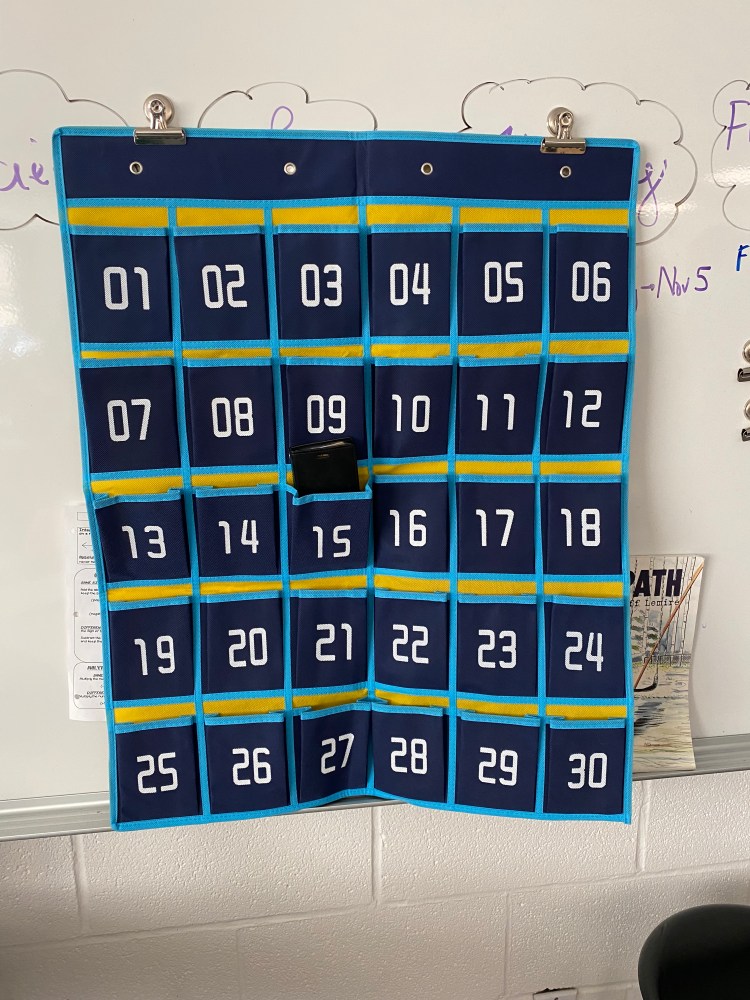
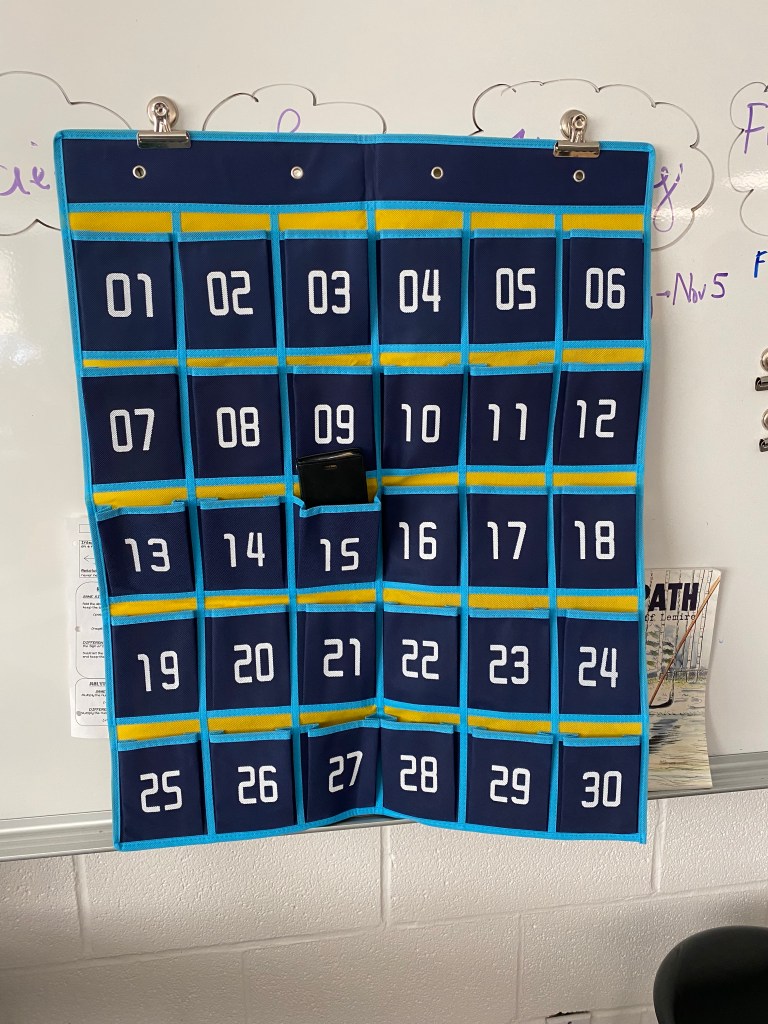
We noticed on line that schools could purchase locking mini cabinets that could be installed in classrooms so schools could secure cell phones when students entered a classroom. As an elementary school we went ‘low tech’ and purchased for each classroom a numbered pocket chart.  Students were assigned a number based on their class list and when students entered the room for their class period they were asked to place their cell phones in their corresponding pocket.  The pocket chart was hung in a safe area of the classroom, i.e., a corner behind the teacher’s desk.  There, the cell phone would remain until the end of class or until the teacher had a section of the lesson where students could use their own device.  One big issue this solved was that washroom visits, quick trips to the hallway or back to their lockers did not include checking in with their cell phone.  At the end of class the teachers would monitor the retrieval of the cell phones based on numbers, seat locations etc.

Pocket Chart Used to Store Cell Phones

If they did not place a cell phone in the pocket chart it was because of one of three reasons

  1. They do not have a cell phone, or they did not bring it to school that day
  2. Their cell phone was not brought to class and instead is locked safely in their locker
  3. It is in their bag, or backpack in class and will not be seen or brought out during the class, they are planning on using the technology provided within the class

When teachers provided class time for student work that could involve the use of technology a ‘Tech Time’ poster was placed on the board at the front of the class and announced to the class.  At this point students could retrieve their cell phones and use them if they wished. A simple visual, you see the sign, it is okay to use the technology in the room including your own device.

Poster Used to Signal Time for Technology

We did not have any difficulties with this process.  Students were respectful of others’ property and I believe this was all because of the preliminary work and relationship building done by our staff before starting, during lessons and discussed fairly regularly.  As well, students were part of the process to develop the plan.

What did we do if the agreements were not followed?

If teachers saw a student breaking an agreement they would ask for the cell phone and keep it with them until the end of class.  At the end of class they would ask a colleague to assist them with any responsibilities they may have so they could have time with the student.  A conversation would take place putting the onus on the student to talk about the commitment and why the phone was taken.  After a conversation the student had their phone returned.

The expectations were reinforced during the conversation and it was shared that the next time would involve a learning exercise done on their free time.  Students were ask to write or assisted in writing, using the common expectations in order to explain what they had done, what they should have done and what they would do next time (simple three paragraphs).  Depending on the situation, the teacher would date this and keep it on file or decide to have the assignment taken home by the child and have it signed by a parent.  

The parent would be reading something written by their child about the expectations in the classroom.  It was not a formal letter or email from the teacher or school. Written from the child’s perspective, it showed understanding of the expectations and always received great support from the family.  

And finally, if necessary, if difficulties still remained the teacher would give the cell phone to me and I would place it in the school safe.  We asked the child to explain to their parent why this had to occur and I would return the cell phone once I was able to have a phone call or face to face meeting with the parent.  At the end of the day I would contact the families so they were aware we had their personal property in our school safe.  Often parents would drive to the school in order to pick up their child at the end of the day and this provided an opportunity for parent, child and myself to meet.  These conversations were easy to facilitate because the child knew the expectations.  They knew the order of the consequences, and had already done a parent letter. In six years at the school we did not have a child repeat the cell phone in the safe process.

Parents were appreciative because it was all carried out with respect and transparency.  We never shamed the child because we all wanted the same outcome.  We want our students to use the technology.  The parents and the school just want the technology used in the proper way. Students are not sneaking glances at their phone to do school research. 

Once parents found out how the child was using the phone in the school we were able to have a great conversation about the use of technology in schools.  The conversation often turned to why this elementary aged child had the phone to begin with and that the school did have the  ability to supply technology.

Over time we purchased enough technology for student use that the need to bring in their own device was not as necessary, and we remained a BYOD school.  Students still like to bring in their cell phones.  We are okay with that, because of the learning that is involved in creating our agreements as a community and we value the importance of understanding the proper use of technology while at school.  A key lesson even for the adults!

Featured

Connect With Your Community

Interesting Ideas

It is Family Day in Ontario, so it is fitting that I write the blog this week sharing another Interesting Idea in relation to your school community and connecting with families.

One of the single biggest impact initiatives we had at our school was something we called Community Connections.  The benefits were huge and provided a service to members of our community when it was needed most.

Front Entrance Sign for Community Connections

It was organized and run by our English Language Learner teachers as well as our teacher librarian. It provided a regularly scheduled opportunity to reach out to our families and have an event early in the morning right after they dropped off their children.  Parents were invited into our school for some connecting and information sharing.

We were aiming for our new families.  Many of them new Canadians but depending on the session we would have many others that would attend.  We felt it was important to really be thoughtful about who we targeted to attend the sessions.  We discovered a real need in our community to help our new families and wanted them to feel safe coming to an event that was catered to their needs.  So often they would not attend a big school event because of a perceived language barrier or they were overwhelmed by the scale and number of people that would be attending.  They had different needs on top of a desire to be entertained or seeing their children involved in events.

We arranged to have interpreters there for each session.

We would adjust schedules and have teachers or other staff come and introduce themselves and possibly do a presentation.

We would partner with many organizations and services in the community so they were able to share what was available for families really close to home.

Some of the most important topics included:

  • the local community centre, summer programs, programs during breaks.
  • the Public Library outlining some resources and programs available for families, including summer programs. 
  • clothing in the winter ‘winter is coming!’
  • the Police department discussing a sudden rise in fraud cases and what to look for to be careful
  • our School Community Officer joining us to discuss social media. They were able to address social media sites and on line safety with gaming and communication
  • the Ontario progress report card, and term report cards and how reporting may be different
  • what to expect during Parent teacher interviews, and student led conferences
  • how to communicate with your child’s teacher
  • an overview of some well being and mental health resources available to our Milton families.
  • how to get involved in our School Council and/or volunteering in the school
  • the Town of Milton and all the programs and activities they have in their parks and recreation department
  • the services provided by our school English as a Second Language and Special Education Resource Teams
  • After school Tutoring, and child care options for before and after school

Often the returning participants would share with us their suggestions for things that were needed, or what they had discovered and should be shared with others.  It became a very tight and cohesive community group that were always looking for ways to support one another.

Parents attending a Community Connections Session

At every session we would have our Settlement Specialist attend in order to explain her role and how she can help families settle in the community. Provided by the Welcome Centre in our school board the job title was  Youth Settlement / Community Connections Specialist and they were extremely important to us.  From a posted job advertisement here is the short description of their role,

“The H.D.S.B Youth Settlement/Community Connections Specialist will work with schools, parents and community partners in specified communities to develop school community activities and projects which address the needs of students, families and schools in those communities. These activities and projects will support school and system initiatives relating to community outreach and parent engagement, equity and inclusive education, literacy, numeracy, tutoring/mentoring, and interventions for students at risk”

We welcomed all the important people into our school and placed them in the same learning space.  They met each other, and formed connections, friendships and support networks.  Those families that attended in the first few years of the school continued to come back in future years in order to share and support new families that were arriving.  The school building and our team were the connectors.

Think back to the blog discussing the well being of our students.  I highlighted the importance of five words in the work that we do at our schools.  Now that you know a little bit more about this Interesting Idea, look at the words again.  This Interesting Idea is another example of how the important work in our schools is all about: Welcoming, Including, Understanding, Promoting and Partnering.

Enjoy Family Day!

Featured

Annoy Your Staff

Interesting Ideas

I’m sure that title grabs your attention! Before we get to that…

It is an honour that I have been asked by the Halton Learning Foundation to be their Guest Speaker at their Annual General Meeting on Thursday, February 24th.

The Halton Learning Foundation (HLF) were, during my time, and continue to be a big part of our school story.

From myHDSB, the employee hub for the Halton District School Board

“The Halton Learning Foundation (HLF) is a registered charity whose mission is to ensure all students of the Halton District School Board have equal opportunities for participation, engagement and success.


HLF helps eliminate financial barriers to learning by providing emergency funds for HDSB students in need and support for their inclusion in extracurricular opportunities. HLF also disburses grants that help pay for school programs and resources, and offers a number of student bursaries and post-secondary scholarships. “ 

Their own website provides a great deal of information about this marvellous organization.

In my presentation to the donors I will share how we have utilized the HLF in our school in order to support students and their families.  I will be sharing the kinds of requests we made, and how the funds were used for individual students.  I will also be highlighting the school grants we received in order to support our music program, our physical education program and our environmental work.

One aspect of the HLF that I really admire is their understanding that “Within Halton, there is economic diversity from community to community. Some school communities and parent councils have a harder time than others raising funds to assist with additional purchases above and beyond core education funding.” (HLF Website)

Of course, part of my talk will be on the importance of giving.  One reason I was asked to speak is because they know our family has made the HLF one of the organizations that we support financially. I was blessed during my retirement that the staff at Boyne PS made a significant contribution in my name to the HLF.  It is a cause I believe in.  I want to continue to support them and lending my voice to their story is a privilege.

I shared in a previous blog about the idea of having three fundraisers a year.  Work Hard, Be Nice, Make a Difference.  That blog can be found here and although we never really got it off the ground because of the pandemic the plan was in place to have our ‘Be Nice’ event benefit the HLF.  We had planned an Arts evening with a dinner served as a way to highlight the work they do in our school and as an opportunity for our students to shine.  Every parent and grandparent of a performing student would have been in attendance.  Important people from the HLF were coming to address the crowd and a good time would have been had by all.

Back to the AGM. I will be structuring my talk around the AIM model, the Aligned and Integration Model (AIM) for School Mental Health and Well-Being.  You can find out more about AIM here.  We had worked really hard at our school to make sure we ‘welcome’, ‘include’ ‘understand’ ‘promote’ and ‘partner’.  Even with our plans being detailed, thoughtful, and structured we cannot do all this important work on our own.  The needs were too great and that is why we value the HLF.

I am going to finish by sharing that our staff always got involved in supporting the HLF because they saw the work they did to support our families. A lot of our requests were to support new Canadians with food, clothing (winter clothing!) and school supplies.  

One of the staff fundraising initiatives I am going to share is ‘Annoying Song of the Month’

The first week of the month was generally our staff meeting on the Monday, an important Community Circle question to do with students that week AND it also became Annoying Song Week.

For one week, five days, I would play a song over the loud speakers and throughout the school.  It would come on about 10 minutes before supervision began and the students were entering the building.  

You know those final few minutes before the students and all their energy come streaming through the door?  Remember those quiet moments before your tranquility was broken?  Well, I would interrupt those final ten minutes with a song, played on repeat over and over again.  It was the same song every day, and the songs switched each month.  

I don’t want to mention any songs here, just in case anyone happens to be a big fan of any of them, like that one about the new born large fish and their family (sorry, if you now have that earworm floating in your brain!)

We had a lovely decorated container in the main office with HLF printed on the side.  We were requesting pocket change from our staff in order to stop the music each day.  The music would play until we had $20 each day.  Five days in a week, $20 or more a day, $100 or more in a week, ten months in the school year and we were proud to hand over to the HLF more than $1000 at the end of the school year.

One time a teacher called down to the office to inform us that they were having a parent interview at that particular time.  We asked them if they had any change!  Their teaching partners bailed her out and came running down to the office in order to get the noise to stop.

We did multiple genres of music.  The worst in my mind being the heavy metal month, where the song I picked had some not very kind language.  Thank you to my much younger staff who were able to hear the actual lyrics and alert me to the problem I created.  A different song for the remainder of the week!  

You will be able to find many websites that list the most annoying songs of all time.  Hopefully, none of your favourites are there. In the final few months we had many staff suggestions, some I think chosen in order to poke good fun at their colleagues. (maybe a few inside jokes in those selections)

Check out the HLF, they do marvellous work, important work, needed work.

Try out my Interesting Idea for a fun, quick, fundraiser idea to support a local charity or organization.  Annoy your staff for a good cause!  

Halton administrators, annoy your staff for the Halton Learning Foundation.

Featured

Upcoming Professional Learning

Interesting Ideas

If you will excuse me, I am going to do something a little bit different in this blog and promote something.  I have been writing in my blog about my experiences and sharing some ideas that I found to be beneficial to my career as a school administrator.  

I therefore must share that certification in Crucial Conversations was/is one of those important initiatives in my career that has had a profound influence on how I interact with staff, students and their families.  I wish I had the training very early in my career because I can reflect back on some interactions that did not go so well and immediately thought that it was all because of the other person, when in fact having better communication skills on my part would have moved us to completely different outcomes.

I have been asked to facilitate a couple of sessions of Crucial Conversations for the Halton District School Board and I am so very much looking forward to getting back into the content.  Not only is it wonderful to be working with staff again, but the content is strong, I learn something new each time I present the work, and I get to sharpen my skills.

Some of my regular readers of this blog were actually part of a class that had to be stopped way back in 2020.  A course had started back in February of 2020 and was shut down first because of employee sanctions and then the pandemic hit and we were not able to continue the course.  At that time we decided to pause the course so we could continue in a face to face manner when we got through all of this.  Who would have known?  Certainly back in March of 2020 we could not have predicted all that has gone on and the impact on us all.  We are getting in contact with the 40 participants now to see if they will commit to completing the course in a virtual learning environment in order to get their qualifications.  I look forward to catching up with these wonderful people.

I will also be running a new group of individuals through the course. Details will be coming out soon.  I will tweet out information about registration once this is established.  Follow me @petermconsult.  Lucky me to be doing two sessions, almost back to back to provide such valuable learning for these people.

During my time away from the material there has been a rebranding.  Crucial Conversations is now called Crucial Conversations for Mastering Dialogue which is a marvellous title that captures the essence of the program. The company even went through a rebranding and is now Crucial Learning, leaving behind their previous name of Vital Smarts.

Read the entire article about the name change from the Crucial Learning website found here.

A small section from that article states, 

“The company’s new name Crucial Learning communicates two powerful ideas that embody the company’s mission and focus. First, the courses teach essential or “crucial” skills for the moments that have the greatest impact on life’s most important outcomes, including the strength of relationships, career satisfaction, happiness and ability to manage stress.

Second, the word “learning” emphasizes that learning and growth do not end with a singular course or even an advanced degree. Life itself is a continual learning journey that presents different challenges at different times. Being equipped with the right skills can lead to better outcomes and improved relationships.”

A little bit more about Crucial Learning

“Formerly VitalSmarts, Crucial Learning improves the world by helping people improve themselves. By combining social science research with innovative instructional design, we create flexible learning experiences that teach proven skills for solving life’s most stubborn personal, interpersonal, and organizational problems. We offer courses in communication, performance, and leadership, focusing on behaviors that have a disproportionate impact on outcomes, called crucial skills. Our award-winning courses and accompanying bestselling books include Crucial Conversations, Crucial Accountability, Influencer, The Power of Habit, and Getting Things Done. Together they have helped millions achieve better relationships and results, and nearly half of the Forbes Global 2000 have drawn on these crucial skills to improve organizational health and performance.”

I am a certified trainer in Crucial Conversations for Mastering Dialogue, Crucial Conversations for Accountability, The Power of Habit and Getting Things Done.  I wrote a previous blog about Getting Things Done on September 27, 2020 and it can be found here.

Why I support Crucial Learning programs and continue to teach for them is because the courses focus on these vital behaviours that improve relationships and accomplish key results.  It is all based on solid social science research while teaching practical skills.  And while these skills never are perfected because interactions with others involve many contextual nuances having the skills is comforting when approaching a crucial conversation or when you suddenly find yourself caught in the middle of one.  The learning is fun, interactive with modern training scenarios and videos that really have you reflect on your communication style and work towards improvement.

My success as an administrator was strongly influenced by these courses and I continue to use the skills daily in my personal and new professional life. 

Many of you have taken this training with me in the past and received certification.  I was really pleased to see that the content has been redesigned.  New video content, new modern work place scenarios have been included as well as some important changes due to current research.

If curious, read about the new course material for Crucial Conversations for Mastering Dialogue here.

A key difference is the coming together of two courses under the Crucial Conversations name.  I have shared content from the Crucial Learning website here.

Crucial Conversations® for Mastering Dialogue (formerly Crucial Conversations)

“At the heart of healthy and high-performance organizations are people willing and able to hold Crucial Conversations. The award-winning Crucial Conversations® for Mastering Dialogue gives people the skills to transform disagreement into dialogue for improved relationships and results. With skills to speak their minds honestly and respectfully, people collaborate better, make better decisions, and foster workplace cultures of trust and respect. The course is available in on-demand, virtual, and in-person learning formats.”

About Crucial Conversations® for Accountability (formerly Crucial Accountability)

“Crucial Conversations® for Accountability teaches a process for managing performance—from coaching through behavioral challenges to helping people identify and achieve goals. Anchored on principles of effective dialogue, this course teaches skills for holding peers accountable regardless of power, position, or authority. The course is available in on-demand, virtual, and in-person learning formats.”

It is a wonderful feeling to be a student again.  Sometimes in our role as leaders we learn as we go and many times don’t necessarily pick the content. Invest in your professional learning and if you ever have the opportunity to take one of these courses I strongly recommend it.   As an instructor I love learning alongside others and each class reinforces and teaches me again and again.  I appreciate my relationship with the good people at Crucial Learning and I am really looking forward to facilitating again in the coming months.

Featured

Cell Phone Problem

Interesting Ideas

Back at the beginning of November I wrote a blog about the cell phone problem we had at our school.  Those that read the blog were able to learn how we worked as a school, staff and students, to make sure we had a co-created plan in place so technology could be used in the correct manner.  In the blog I spoke about the fact that the problem was not necessarily the cell phone, it was what the student was doing on the cell phone.  As educators we all know the proper use and purpose of technology.  It is not ‘that’ a phone was used, it is ‘what’ the phone was being used to do.  Using the device as a learning tool is what needed to be clarified and understood by everyone.  When phones are used for this purpose all is good.

But admit it, it still troubles you as an administrator to see a student with their head buried in their phone because you are questioning what they are doing.  Go back to that blog if you want to know how we came up with common expectations for student cell phone use.

I teased in that blog that our cell phone issue was not a student issue, it was in fact an adult problem in our school and in a future blog I would write about dealing with staff cell phone use.  That blog is now.

 I had much more difficulty as an administrator when I saw an adult with their head buried in their phone because I was questioning what they were doing.

So while some may have come to the blog immediately thinking I was speaking about the student population I actually spent more time thinking about, worried about and trying to problem solve as a leader about the adults not using their cell phones in the proper way in the school.

We had adults in the hallway in front of others on their phones.  Remember, it is not the phone, it is what they are doing on the phone.  During work hours, when the adults are working with students, there is proper use of a device and there are times when it is not appropriate.  If they were using their phone to capture notes, take a photo, record a memo for the purposes of our students and learning that was a different issue.  

I have walked passed classrooms and looked in to see adults working with a small group of students and on their phone.  I have seen adults caring for a single child requiring an individualized program of instruction, and on their phone.

Do your staff have their phones out while with you at staff meetings or professional learning sessions?  What are they doing on their phones during those times?

So what to do?

We can all agree, there is a time and a place.

As a leader?  You say nothing, and you allow it to continue.

There are situations where it is not acceptable for the adults to be on their phones while working with students.  So do you speak up?

Now obviously we need to be connected to our families.  The young ones we care for and older family members that may require our support. There was a time when the only option for someone outside the school to contact me was through the school office.  I understand when staff members share with me their need for their phones to be with them in order to stay in contact.  If an emergency would arise, we would find another adult to take their place, ensure students are properly supervised and allow that staff member to go to a quiet, private place to make sure everything is okay.

As a leader you have a standard in your mind about student and staff interactions.  How staff use their cell phones while working with students must be an expectation that you have.

If you have set a standard, you either lower the standard when people cannot match the expectation, or you don’t want to enforce it. Or you have good conversations with your team about the expectations and coach and help people to achieve the expectation.  Over time, has the expectation slipped to the point where you have an adult cell phone issue in your school?

We were problem solving with our students about the use of cell phones in the school. We wanted student voice to come up with common expectations. It was during our classroom community circle conversations that we had each month (Significant 72…72 minutes a month, read about that in the blog on August 30, 2021) that some senior students shared that the adults in the building were being hypocrites.  “They are always telling us to get off the phones, put the phones away, but they are on them all the time”.  Even some of our students were seeing the modelling done by the adults.  Is this the example we want to set in a school?

We would always share the comments from students each month after our Significant 72 work, so here was a great lead in for our next staff meeting.  Are we bad role models?  Table groups were able to have a conversation about what the students were saying.  Some wise voices in the group got it, they understood and were embarrassed. It really was a great conversation starter and after some discussion we came up with the following plan.

We were all going to do a better job of being on our phones and modelling for our students the proper use of technology. 

We were going to announce to the students whenever there was a moment we wanted to ‘capture’ in the class or working with a group.  We were transparent to those around us when the phone was out and being used, and sharing how it was being used.  What a great example to set for our students when they are using their phones!

When we were going to use our phones to catch up on our lives, it was during our breaks in common staff areas such as the staff room or workrooms.

And if we saw another staff member in a common area, where students could see the adults using their phones, they would smile at their colleague and simply say, ‘It’s work, right?’ And jog their memory.

Some of us would smile and say, ‘what good stuff are you capturing right now?’

Often people would smile and say, ‘yep’ and then put their phone away, but the point was made.

We policed each other.

It may sound heavy handed, but the message was sent to staff and reinforced.  We are here for the students.  When working with the students they have us 100%.  

We are not asking you to use your own phone for school purposes, in fact we would prefer that you don’t use your personal device.  We have lots of technology available in the school for you to have a classroom device for tracking, recording, note taking, photographs etc

As a leader, if it bothers you, say something.  Do something about it.  Start with some candid, respectful conversation about what you see as an issue.  All our staff had been trained in Crucial Conversations for Mastering Dialogue, so we were accustom to having uncomfortable discussions at times.  Take the course if you get the chance.

A hard conversation to have at the start, but so much nicer than being a leader that has to say, ‘put your phone away’.

Do cell phones in the hands of the adults bother you at school?

Be really transparent. Use your phone for work if you wish but announce what you are doing. And if you see others, smile, and discretely remind the person of our common commitment to ourselves and our students.

Put your phone away while working with children or other staff (staff meetings included!) 

Featured

Protect Instructional Time

Interesting Ideas

Moving from school to school is part of the job for an administrator.  It is both exciting and anxiety provoking.  Starting with an entry plan for the new location is key.  Each time I have moved I have done an activity with staff that I called ‘Successes and Barriers’.  I want to find out what creates the greatest pride in the school and also what are the ‘things’ that get in their way and prevents them from doing their absolute best for the students they have in front of them.

The most common response for teachers listing their barriers, is “time”.  Every teacher wishes they had more time.  They wish they were not impacted by a sudden bell that rings and interrupts the amazing lesson that is happening, when all students are fully engaged and in a flow.  At times they wish they were not interrupted by the public address system or other school wide events that do not pertain to them. They also wish they had more time with their teaching partners or division or same subject teachers during preparation periods in order to ‘talk shop’ with someone that understands their assignment.

Instructional time is so important for student learning. How we use it and abuse it is an important thing to consider within a school.  As a school leader there are numerous structural things that you can do that impact the sanctity of preserving instructional time.

The school board that I worked with for 33 years now has a balanced day schedule.  The Canadian in me always described this to my American friends as the classic hockey game.  We had 100 minutes of instructional time, then a 40 minute break (intermission), another 100 minutes of instructional time, a 40 minute break and ending with a final 100 minutes of instructional time.  This was not always the case and I remember beginning my teaching career with two 15 minute recesses and an hour lunch in the middle of the day.  This model is still used in numerous school across North America.

Think of the time spent in transition?  Students needing to get ready for break, getting dressed to go outside, grabbing a lunch or snack and then repeating the process in reverse to start up again.  I read somewhere that each transition loses approximately 5 minutes (if done well) off of instructional time.  Teacher contracts mean that there is a clear distinction between break time and instructional time.  If students and staff don’t utilize opportunities during non instructional time to prepare for instructional time then all the time lost comes from the instructional day. Three breaks in a day equals 15 minutes a day of lost instructional time, which is over 46 hours in a school year.  Even with our balanced day schedule we were still losing close to 32 hours in the year.

What could I do as a leader to show I value instructional time and then structure the school in a way to maximize our time in class? By modelling the importance of instructional time to staff the message became pretty clear that class time was going to be used well.  It helped me as a leader have the conversations with staff when students were not active users of class time. We can all think of class activities that are not a good use of time, we also know the importance of slowing down, having breaks during instruction and having fun and building relationships with students.  All of these examples are important to do during instructional time, I’m just commenting that there are some classroom practices that do not honour the importance of using time well.

In the creation of the timetable we wanted to make great use of the full 100 minutes of the instructional block.  This most commonly meant students staying with their teacher for the entire 100 minutes before the next break.  Some classes needed to be scheduled for shorter lengths of time (French, physical education, music, visual arts etc) so we would work to make sure two classes occurred during that time.  If a class was going to leave their teacher for a French class, they were also going to have another subject not taught by their teacher during that 100 minute block.

This allowed us to be targeted with our preparation time schedule.  For example, one grade four class has French/music, while another has music/French.  Now those two teachers have a common prep period together for half the time, and the other period could be used to provide coverage to two teachers (primary teachers) of another grade so they are together.  As much as possible the timetable was written with the idea of giving the opportunity to teachers to be with others in their grade, division or same subject

Teachers of home room classes loved having their classes to begin the day.  The first 100 minutes were considered golden time and they did not want their classes moving through the school to other subject areas.  So our coverage teachers and specialist teachers without homerooms would have preparation time in the morning.  And if a class did have an interrupted first block, we made certain that it occurred only once in a week.

One of the best ways to honour instructional time revolves around announcements.  We put all our announcements in a shared document that could be read/displayed by teachers when they wanted to share it during the first large block of time.  Announcements needed to be done some time prior to the first break so students were aware of any extra curricular activities that may be happening during that time.  Our primary teachers in particular loved not having the morning learning time taken up by school wide messages that had little to do with their students. 

Our national anthem was integrated into our bell system and would start to play at the same time every morning.  It indicated to students, families and staff the official start time of the school day.  If you arrived at school after O’Canada, you were late for school that day.  I did not get on the p.a. system and ask for everyone’s attention, did not ask them to stand for the national anthem, it just started playing.  Everyone would stop, stand and begin the day.

As mentioned, teachers appreciated using the announcements in a way that best served their students and their instructional time. They often found that the content in the announcements did not pertain to their students.  We found lots of ways to celebrate the accomplishments of our teams, bands, clubs and individual students outside of using the PA system to stop the entire school.  Teachers would review the announcements in the morning and determine ‘when’, ‘if’, and ‘how’ they would share the news of the day.  Birthdays were recognized within individual classrooms.  

Some classes wanted to give the leadership opportunity of reading announcements to their own students. One of the classroom roles for students would be the ‘announcement reader’,  a rotating group of students who would share the announcements with their own class, a joke of the day, birthday wishes etc.  Relationship building, class togetherness, leadership opportunities within each class instead of one or two special students getting to do it for the entire school!

At each transition time we had a warning bell.  It would ring two minutes prior to the bell that signified the start of the next instructional period.  This bell signified to staff that students would be starting with you in two minutes and since instructional time is your teaching time, the expectation is that you are with your students at the start of that time.  Therefore, you have two minutes left in your break before you need to be where you need to be.  At the start of the instructional time, every staff member who was on schedule for that time was in the hallway, on the stairs, outside at the doors and greeting children.  No one was in their classroom waiting for their students to get to them.

Every administrator knows that it is during this moving time when trouble begins.  Since transition time was not built into the timetable, and we had over 1000 students, all staff teaching at those times was working and therefore visual for the students moving from outside to inside, and inside to outside.  It allowed our staff to engage with students, welcome them, high five, fist pump, ‘so glad to see you today’.  A simple thing that is so important.

A common phrase outside with our students was ‘beat the bell’.  After the first bell (warning bell) would ring students were asked to be in their lines, or in the school before the next bell rang.  We had a large field, so after the two minute warning bell, it would take that amount of time to clear the field and get students onto the pavement and near their entry door.  Because the second bell was the start of instructional time, they were greeted by all the staff that were beginning the next class period to get them into the building, into their classrooms and ready to learn.  It allowed transitions to be done quickly, done safely and smoothly because every staff can be involved.  I can guarantee that it did not take 5 minutes out of instructional time to be ready to go because of the use of the warning bell and then all staff ‘working’ to get students settled.

And finally, how often does your school allow someone to get onto the PA system and make an announcement in the middle of instructional time?

How often is a child called down to the office to receive a message or item left at home?

Are messages broadcast through your entire school that are targeted to a single student or class?

I cannot say I value instructional time and then allow office staff or myself to continually interrupt the learning in the school.  Find another way. Don’t interrupt the learning of the entire school to get a message to one class or one individual.  The first year at a different school would be an interesting time as they got to know me, because I did not allow anyone in the office to use the PA system without asking me first.  I’m curious what they said under their breath if they were used to doing things a different way in the past.  In almost all cases I would take the message or item to the classroom or student myself, right in that moment (two minute rule) and I didn’t do it for that particular family or child.  I walked through the building to see everyone, I was visible in the school delivering items in order to protect the learning time of the other 1000 students in the school.

Walk the walk, talk the talk and protect instructional time.  When you become a school leader who has worked with staff in order to protect and optimize instructional time it is now easier to begin those conversations with teachers when class time is not being used well.  Hard conversations for sure, but having been very public in our beliefs about the importance of instructional time it is now easier to begin to ask good questions about the practices occurring in classrooms.

Featured

Charities & Schools

Having a Process.

interesting ideas, light bulb to indicate a great idea

Interesting Ideas

I know and understand that it is extremely important for a school to be involved in the work of local charities.  The learning that students acquire by giving to others is a key part of any curriculum.  The positive feelings and acknowledgement you receive as a school for giving back cannot be measured, but is certainly felt when the school rallies around a great cause. 

A lot of organizations have committee members, volunteers and employees that create materials for schools in order to promote their charity.  Some of these are classroom activities, materials for the students or events that can be run to show school spirit and bring awareness of the need. 

As a school you may have particular causes that are near and dear to your heart because there is a direct connection to a child or family at your school.  With a large staff, it is difficult to find someone on staff that has not been impacted by an illness or event in their lives or to their loved ones or family.  By their very nature, those in education are very giving people.

For the purpose of this blog I am writing about fundraisers that involve the school where 100% of the donations are passed forward to the organization.  There are other school fundraisers where families participate in an event for the school, or purchase food, spirit wear clothing etc where the funds remain with the school or remain with the parent run School Council.

Early in my administration career I moved to a school as the Principal where there was a special event-fundraiser for charity each month.  Every month a notice would go home to parents from the school about how funds could be given to a particular organization for that month.  Therefore, in total, 10 different organizations were provided access to our community through our school.

Each event and every charity had a story.  It might have been a student from the past and the school continued to work with the organization.  I came to understand that over time it had grown to the point where every month was designated as a special event/charity month. I was provided with a calendar when I arrived.

As I was doing my entry plan into the school I did hear from parents, and staff about this.  It was almost a ‘undiscussable’ as most people were uncomfortable bringing it up and not wanting to look uncaring.  They did want me to hear their concerns and had some difficulty finding the right words.

The loudest voices I heard were from the parents.  They felt pressure because it was supported and run through the school and they wanted to assist because their children were watching and listening to the attention that was given each month.  Many families spoke about how they have their own charitable donation plan as a family.  They were good people who wanted to assist, and were in a position where they could, they just really felt uncomfortable with ‘so many from the school’.

I also heard from staff who felt the burden of promotion, collection and discussion each month.   Since many of the organizations had activities or events, they felt it was taking away from classroom instruction. They became tired during the year, as one event ended and another was about to begin.  Staff that had been at the school the longest were the ones that were looking for change.

The fundraising initiatives were strongest at the beginning of the year and by the end of the year the total dollars collected showed a noticeable drop.

I heard from others that were proud of the school’s reputation of caring so deeply for those that required support.  Some felt it was the essence of the school.

So, how do you still participate in such a valuable endeavour?  How can you show your community that you understand there is a responsibility to the community and our student’s learning?  How do we model to the students that we are here to ‘make a difference’ by giving to others when we are in the position to do so?  

And, at the same time (the power of ‘and’) not step over the line when it simply becomes too much.

It was a hard task to pull back on those habits and traditions that had become established.  You can probably imagine the investment in some of the events, the connection to some of the organizations and how difficult those conversations became when in the second year we cut the number of school charitable events in half.  We shared with families our plan, still encouraged families to participate as a family as they wished, however, using the rationale of classroom time and connection to our school at the current time, we would be moving forward with this new plan for the year.

When I moved on and had the opportunity to open a new school I was not going to have a repeat of this.  As I have discussed in previous blogs, it was the use of our school mantra, “Work Hard, Be Nice, Make a Difference’ that provided us with the rationale, and purpose behind our decisions.

We were only going to do three.  If the School Council wanted to organize an event for charity they were welcomed to do this, as it was their initiative.  In my time at the school, our council only did events to supplement the finances of the school.  The school itself, however was only going to do three in a year and they were going to connect directly to our mantra.

And the three we were going to do would be done in a spectacular fashion.  We involved the entire community, and all classrooms because they were special events done one each term.

The three events were organized as this:

One event that was connected to the mantra section, ‘Work Hard’.

One that was ‘Be Nice’ and a third, ‘Make a Difference’.

It is easy to see how our partners in the charitable organizations could work with these descriptors and as a school it was another way for us to connect with students and families the importance of the wording in our mantra.

For example, the first major event in the year was right near the beginning and was done under the description of ‘Work Hard’.  In my time at the school this event has been the Terry Fox Run/Walk for cancer research.  Students learned all about Terry’s story through the additional lens of ‘Work Hard’. As an entire school event we were able to incorporate assemblies, classroom lessons and incentives while students new to us learned about the importance of working hard.  Senior students were partnered with our youngest students and our entire community was able to witness our students dressed in their red and white to bring awareness to this cause.

Senior Students Participating in our Terry Fox Event with Little Buddies

We would have another event in the middle of the year targeting a different charity tied to our mantra piece of ‘Be Nice’ and a third and final one at the end of the year to ‘make a difference’.

In my final year at the school:

Work Hard…Terry Fox Run/Walk for Cancer Research, 

Be Nice … the Halton Learning Foundation to support students and families in our own community, and

Make a Difference, Jump Rope for Heart for the Ontario Heart and Stroke Foundation

Each year we would have what is called a School Directions Meeting to review with staff the three events we held and what should/could be done for the following year. 

We felt this meeting process was transparent and it was open to all staff.  We invited all staff to attend and share their ideas.  As the meeting was advertised well in advance staff knew they were coming to participate in a process to select our three events for the following year.  Staff were able to participate in a facilitated discussion and the problem solving and selecting that would need to occur in order for us to come down to our final three.  This was an opportunity for me to share with staff how to facilitate this kind of discussion where a decision was needed to be made while valuing differing view points. Every year we had changes and over the course of the time the school has been in operation a wide variety of charitable organizations have been supported by staff, students and families.

This process also allowed us to have something in place when an idea or need was brought to us in the middle of the year.  Also as new staff members were hired, they brought ideas from previous schools and wanted to get something up and running in their new location.  We were able to describe our School Directions Meeting and that a process was in place.  Remember, process is your friend!

If a community member suggested a charity event, or donation activity for the school we were able to provide the same explanation and offer them the opportunity to provide us with materials to be shared.  Or, they could approach the School Council at a regular meeting to share.

If a cold call came into the office from the hard working people that work with local charities we were able to provide them with an answer right away and the process to provide them hope that the answer of yes may come in the future.  Many organizations appreciated our honesty and transparency and congratulated us on having something connected to our school mantra that made sense. 

Connecting your school, staff, students and families to charitable organizations by holding school events is a great way to showcase your school and illustrate to students that we live in a time when those that are able should assist those in need.  The individual stories of the families in your community are varied. Striking a balance is a difficult task.

Here is another ‘Interesting Idea’ of how you can use your school mantra to assist you with your communication and decision making in this area.

Featured

Starting a Movement

Interesting Ideas

I wanted to do something slightly different this week in my blog.  I want to promote a book and illustrate how this books aligns with the important work we did at our school in regards to building and maintaining our positive school culture for staff, students and families.

The book is Starting a Movement: Building Culture From The Inside Out in Professional Learning Communities by Kenneth C. Williams and Tom Hierck.  It was published in 2015 by Solution Tree Press and I highly recommend it to the readers of this blog.

The book delivers on its promise, printed on the back cover,

“Educators will:

  • Learn to express, clarify, and align their beliefs so that they are meaningful to teachers, staff, and other stakeholders
  • Create maximum buy-in among all members of the school community
  • Use the authors’ authentic alignment model to help keep their actions aligned to their schools’ mission and vision
  • Reinforce the researched, results proven PLC within their school culture”

It is time for you to take a close look at your school’s mission statement.  If it is working for you and you feel that it is well established, then at least look at the benefits of working with staff, students and the community to develop a school mantra.  This book with help with this process.  Your leadership will receive a major positive boost by doing this important work with your school.  The outcome of this work will impact many aspects of your school culture.

Our school started in September of 2015 and the book was published the same year.  I did not have a copy of the book prior to the school opening so it is after the fact that I noticed the connections. 

Prior to the school opening I had already used the saying “Work Hard, Be Nice, Make a Difference’ at other schools where I had been the principal.  Those other schools had a mission statement, created before my arrival.  So like many of you, I inherited a mission statement. There is an interesting discussion in the book about existing school mission statements and if they are known, utilized, understood or believed.  This particular section of the book will allow you to have a really critical look at your school’s mission statement.  

I didn’t realize it at the time, but by adding that saying into those schools on top of the mission statement, I was doing something that the authors share as a really positive action.  And it is not just the saying itself, it is the process and the actions taken in order to develop the saying.  Most importantly it is what  you do with the saying once established.  Don’t allow it to simply be writing on the letterhead.

Now is the time to reexamine your mission statement and the authors provide a process for doing just that. 

Although I did not have a copy of the book, I feel I had something better in place prior to the school opening and that was the guidance and mentorship and friendship of one of the authors, Tom Hierck.  With Work Hard, Be Nice, Make a Difference established in my mind to share with staff I had long conversations with Tom about bringing something ready made or developing it with the staff in the first year of the school.  I was put in a tough spot in a sense because the school needed to exist on line, on paper and in communication with the community prior to the bricks and mortar being in place.  The school officially started without staff in a sense. The school also opened under teacher sanctions and I was not able to have access to the staff to do this planning work.  

The saying was discussed with staff, and the rationale provided.  I started to use the phrase when visiting the students that would become Boyne students.  From the first time I met students, they heard, ‘Work Hard, Be Nice, Make a Difference’.  At parent evenings prior to school construction, families were meeting me, learning about my vision and plans, and hearing, ‘Work Hard, Be Nice, Make a Difference’. In a presentation for prospective staff interested in beginning this new school journey with me, they heard, ‘Work Hard, Be Nice, Make a Difference’. 

In all honesty it would have been difficult if staff were not in agreement or if they wanted to develop something right from the start.  It would have been a hard conversation for someone to speak up and say we should have something new that I had not used before.  I believe I was open and transparent in that work, and have come to understand through their acceptance, adoption and love for our saying that they are happy with the results.  Students and families continue to comment positively as well.

So for this blog I will be sharing key quotes from an important chapter in the book and reflecting on the quote with practical, real life examples of the work in action.

I have been using the term ‘saying’ and ‘mission statement’ in the first part of this blog. In fact what we have according to the authors is a school mantra. ‘Work Hard, Be Nice and Make a Difference’ is not a mission statement but in fact a mantra based on our mission, vision, values and goals.  It is longer in length than Williams and Hierck would suggest for a mantra but I’ll get to that later.

I want to introduce you to Chapter 3 in the book, entitled Exploring: The Why

‘the Why, is the process of examining your fundamental purpose and core beliefs.  Your goal is to capture the essence of your school’s mission in a guiding mantra to help strengthen that mission’

Starting a Movement: Building Culture From The Inside Out in Professional Learning Communities by Kenneth C. Williams and Tom Hierck (p.55)

All the things we do at the school connect to our mantra.  Our commitments to each other come from these three statements.  Our classrooms begin the year by using Significant 72 (a previous blog) and developing with students how we are going to be a community by illustrating working hard, being nice and making a difference for ourselves and others.

Consider your existing school mission statement…

‘We propose taking one small and powerful additional step in this process: extract a non-negotiable ideal and distill it into a three to five work expression known as your guiding school mantra. Develop a mantra that captures the essence of your school’s mission in a concise and repeatable way.’

Starting a Movement: Building Culture From The Inside Out in Professional Learning Communities by Kenneth C. Williams and Tom Hierck (p.62)

So all this time I may have felt we had our school mission statement when in fact we had our school mantra. It is longer than the 3-5 word suggestion, however its simplicity makes it stick.  The three aspects of the mantra allow us to use each part separately and all together.  I still see it as concise and definitely repeatable.

‘Schools should identify the fundamental purpose, then use that purpose as the lens through which to guide decisions. We know it works for some schools, but often the outcome is a product; the mission statement.  We rarely see a unifying force that empowers educators to examine, clarify, and align every aspect of the school.’

Starting a Movement: Building Culture From The Inside Out in Professional Learning Communities by Kenneth C. Williams and Tom Hierck (p.56)

‘Because the typical mission statement rarely serves as a guide to inform your choices, behaviours, and decisions, it is, in essence, ‘fluff’. When you consider the time spent creating a mission statement versus the fact that its ideals seldom trickle down to the daily work of teachers and leaders, it’s easy to understand the cynicism that arises.’

Starting a Movement: Building Culture From The Inside Out in Professional Learning Communities by Kenneth C. Williams and Tom Hierck (p.58)

There are times when we need to support students and some of the choices they make.  We would use our mantra continually. Some students need a reminder conversation from staff about how we were going to work together and how the adults can support them with their lagging skills.  Their troubles began with a situation where they were not working hard or not being nice.  A conversation out of class or in the office area would start there.  They are removed from their peers in order to get support because they are not working hard or not being nice.  Now that we have that as a starting point, what are we going to do to go back to the situation and make a difference for yourself and others and how can we help you?

‘Yet in almost every instance when we ask staff members to identify agreed-on ideals around which the entire school rallies, to identify a non-negotiable idea that guides the daily work of their school, to state the agreed-on purpose that serves to both compass and guide for every important decision made on campus, we almost never see agreement on what that guide is’.

Starting a Movement: Building Culture From The Inside Out in Professional Learning Communities by Kenneth C. Williams and Tom Hierck (p.56-57)

‘the conversation turns to the school mission statement-the statement that everyone knows exists but no one can connect to the daily work of teaching, learning, and leading’

Starting a Movement: Building Culture From The Inside Out in Professional Learning Communities by Kenneth C. Williams and Tom Hierck (p.57)

‘The stated mission should permeate every aspect fo school life.  It should serve as your school’s rallying cry and ultimate litmus test to determine what is best for improved student learning; you should not view it as an opportunity for positive public relations that eventually fades into obscurity’

Starting a Movement: Building Culture From The Inside Out in Professional Learning Communities by Kenneth C. Williams and Tom Hierck (p.57)

Every classroom, and every student is involved in the process at the start of the year and then monthly check ins (Significant 72) about our commitments to each other.  Kindergarten students are able to share with staff what it looks like and sounds like to work hard and be nice.  During nutrition breaks when we are eating in our classrooms prior to going outside, grade eight students are able to share what this non instructional time looks like using ‘Work Hard, Be Nice, Make a Difference’.  Our School Council of parents are able to create their meeting norms using ‘Work Hard’ ‘Be Nice’, ‘Make a Difference’. In the gymnasium, students are able to articulate the mantra. 

An interesting aspect of the chapter comes later when Williams and Hierck offer a caution. They guide you and want you to avoid something they call ’t-shirting’. 

‘It means you place more emphasis on slogans for t-shirts, lanyards, coffee mugs, bumper stickers, and banners than on how your statements actually guide instructional and assessment practices and interventions.  In our experience, few can articulate how their statement explicitly manifests itself in daily work’

Starting a Movement: Building Culture From The Inside Out in Professional Learning Communities by Kenneth C. Williams and Tom Hierck (p.59)

To be honest we have t-shirts for staff, and the mantra is on the walls, but it is so much more than wallpaper.  Our interventions program named WIN (Whatever I Need) is driven by making a difference, it is in Significant 72 (previous blog), establishing our agreements (previous blog), in report cards learning skills(previous blog), in our graduation ceremony(previous blog), in Kindergarten celebrations, and in our fundraising initiatives.  An event does not occur, a report is not written without using the lens of our mantra. 

We got this!

‘Ideally, your mission statement would permeate everything you do at school – embedded in your school’s culture, committed to memory, modelled, and intrinsic to daily life’

Starting a Movement: Building Culture From The Inside Out in Professional Learning Communities by Kenneth C. Williams and Tom Hierck (p.62)

‘It can be a short, energy-infused statement around which your school organizes; it defines what you are and guides all internal decisions.  Further, it’s a powerful chant that everyone inside your school can instantly understand, recognize, and repeat-a constant reminder of what you can expect from each other.’

Starting a Movement: Building Culture From The Inside Out in Professional Learning Communities by Kenneth C. Williams and Tom Hierck (p.62)

At assemblies I would often begin the mantra and only have to say ‘Work Hard’ before the students would complete the phrase in unison.  We have yearly student and parent surveys and we are able to insert our own questions at the end in order to get specific data or feedback.  We have inserted the statement and asked participants in the survey to complete the phrase, ‘Work Hard, Be Nice, ….”  98% of our students completing the survey were able to answer correctly, our parent responses were not quite as high but still a large majority or our parent community were aware of our mantra.

Hopefully, I have been able to share with you the power of having a school mantra.  Not only the development process is important to the school culture, but the continuation of a positive school culture is predicated on having common expectations that everyone, like Williams and Hierck write, ‘instantly understand, recognize, and repeat-a constant reminder of what you can expect from each other’ (p. 62)

So I leave you with two thoughts.  The first, do your staff, students and community know your mission statement?  The authors make a terrific point,

“We often ask our workshop participants to share their schools’ mission statements from memory.  What follows is often a complete loss of eye contact, uncomfortable shifting in chairs, the sudden emergency cell phone call, the impromptu bathroom break, the nervous laughter-all clear signs that people don’t know’

Starting a Movement: Building Culture From The Inside Out in Professional Learning Communities by Kenneth C. Williams and Tom Hierck (p.57)

And finally, check out Starting a Movement: Building Culture From The Inside Out in Professional Learning Communities by Kenneth C. Williams and Tom Hierck. On page 65 look at ‘Creating Your Guiding School Mantra: The Tip of the Iceberg’ 

Do this exercise!

Re-culture if it is needed, rebrand with a mantra. It is so beneficial for students, staff, families and for your leadership.

Featured

Cell Phones at School

One School’s Story

Interesting Ideas

We had a problem with cell phones at our school!  

I want to share one school’s story on how we worked with students, staff and families to address the issue.  

I will start by saying we are an elementary school so our solutions are based on one thousand plus students in Kindergarten to grade 8. 

While walking in the hallway it was not uncommon to see someone walking with their head down and staring into a screen.  Or walking past a classroom and glancing inside to see someone in a group of students with their heads in their phones. Or off to the side of the room while everyone was working, on their own, on their phone.  And in all of these examples I am speaking about the adults in the building. Adults on their phones when working with/for students.  Not okay.

How we discussed this and solved this as a staff professionally and respectfully is going to be the topic of a future blog.  I’m sharing this as a bit of a tease because in this blog I want to share how we encouraged proper technology use by students in our school.

We were a BYOD school (Bring Your Own Device).  This was especially important in our first few years when our student population was high and our number of school owned devices was still low.  Senior students were invited to bring their own device to the school to use in their classrooms.  It was not a requirement.  We made sure families understood we always had technology available for student use.  We did not want students going home and saying they had to have technology for school!

Letting students use their own device did really help everyone at the beginning.  Everyone likes using their own devices for comfort and ease.  We know how to navigate our own tools and where we keep files and work.  We were confident that done properly, and with student voice and family input we could create a process that would work.  We wanted it to work, technology is an important tool and part of the learning process includes how students use technology effectively, properly and respectfully.

We followed all the board issued mandates with families about loss, theft and damage.  We gathered all the required paperwork and then started on our journey with students to formulate how this was all going to be operationalized.

Staff created schedules in order to share the technology we had on hand.  Most importantly the staff developed an understanding that the technology is a tool to be used by students when needed and really limited the amount of time where every child needed a device at the same time. We have moved way past a time when all students are using the same program at the same time, in the same way and instead allow students’ choice in how they demonstrate their learning. With a heavy emphasis on differentiated instruction and student choice, gone are the days when you would see the entire class in a computer lab or each child at a workstation.  Computers, and tablets are in the classroom available to students to use as needed.  Also available to students is their own device if required.  So how do we monitor the proper use of these powerful tools?

I can remember very early in my administration career, when cell phones were just becoming a thing you would see at school.  They were considered a distraction, a nuisance and we banned them.  We could not understand why any elementary student would need a phone at school if there were pay phones and office phones.

We now have a better understanding of the power of the devices in student hands.  It is not the cell phone itself that is the issue, it is what the cell phone is being used to do.  Parents provide or allow cell phones for their children for many reasons. It is important for our families to know that when at school the cell phone is being used in a responsible and respectful way. Cell phones are a wonderful tool that when used well, and used properly can and should be a learning tool that students learn to use appropriately. They are not going away.

Listening to student voice was always a key strategy in our school and how we were going to use technology in our school was another opportunity to hear from students.  Using our school motto of ‘Work Hard, Be Nice, Make a Difference’ we developed our agreements.  These were developed with our classes, shared with everyone and are reinforced with students multiple times in the year (Significant 72 opportunity).  You will see that students did come up with agreements around non-instructional time as well as instructional time. A copy of the poster that hangs in each room is shared with you here.

We noticed on line that schools could purchase locking mini cabinets that could be installed in classrooms so schools could secure cell phones when students entered a classroom. As an elementary school we went ‘low tech’ and purchased for each classroom a numbered pocket chart.  Students were assigned a number based on their class list and when students entered the room for their class period they were asked to place their cell phones in their corresponding pocket.  The pocket chart was hung in a safe area of the classroom, i.e., a corner behind the teacher’s desk.  There, the cell phone would remain until the end of class or until the teacher had a section of the lesson where students could use their own device.  One big issue this solved was that washroom visits, quick trips to the hallway or back to their lockers did not include checking in with their cell phone.  At the end of class the teachers would monitor the retrieval of the cell phones based on numbers, seat locations etc.

If they did not place a cell phone in the pocket chart it was because of one of three reasons

  1. They do not have a cell phone, or they did not bring it to school that day
  2. Their cell phone was not brought to class and instead is locked safely in their locker
  3. It is in their bag, or backpack in class and will not be seen or brought out during the class, they are planning on using the technology provided within the class

When teachers provided class time for student work that could involve the use of technology a ‘Tech Time’ poster was placed on the board at the front of the class and announced to the class.  At this point students could retrieve their cell phones and use them if they wished. A simple visual, you see the sign, it is okay to use the technology in the room including your own device.

We did not have any difficulties with this process.  Students were respectful of others’ property and I believe this was all because of the preliminary work and relationship building done by our staff before starting, during lessons and discussed fairly regularly.  As well, students were part of the process to develop the plan.

What did we do if the agreements were not followed?

If teachers saw a student breaking an agreement they would ask for the cell phone and keep it with them until the end of class.  At the end of class they would ask a colleague to assist them with any responsibilities they may have so they could have time with the student.  A conversation would take place putting the onus on the student to talk about the commitment and why the phone was taken.  After a conversation the student had their phone returned.

The expectations were reinforced during the conversation and it was shared that the next time would involve a learning exercise done on their free time.  Students were ask to write or assisted in writing, using the common expectations in order to explain what they had done, what they should have done and what they would do next time (simple three paragraphs).  Depending on the situation, the teacher would date this and keep it on file or decide to have the assignment taken home by the child and have it signed by a parent.  

The parent would be reading something written by their child about the expectations in the classroom.  It was not a formal letter or email from the teacher or school. Written from the child’s perspective, it showed understanding of the expectations and always received great support from the family.  

And finally, if necessary, if difficulties still remained the teacher would give the cell phone to me and I would place it in the school safe.  We asked the child to explain to their parent why this had to occur and I would return the cell phone once I was able to have a phone call or face to face meeting with the parent.  At the end of the day I would contact the families so they were aware we had their personal property in our school safe.  Often parents would drive to the school in order to pick up their child at the end of the day and this provided an opportunity for parent, child and myself to meet.  These conversations were easy to facilitate because the child knew the expectations.  They knew the order of the consequences, and had already done a parent letter. In six years at the school we did not have a child repeat the cell phone in the safe process.

Parents were appreciative because it was all carried out with respect and transparency.  We never shamed the child because we all wanted the same outcome.  We want our students to use the technology.  The parents and the school just want the technology used in the proper way. Students are not sneaking glances at their phone to do school research. 

Once parents found out how the child was using the phone in the school we were able to have a great conversation about the use of technology in schools.  The conversation often turned to why this elementary aged child had the phone to begin with and that the school did have the  ability to supply technology.

Over time we purchased enough technology for student use that the need to bring in their own device was not as necessary, and we remained a BYOD school.  Students still like to bring in their cell phones.  We are okay with that, because of the learning that is involved in creating our agreements as a community and we value the importance of understanding the proper use of technology while at school.  A key lesson even for the adults!

Featured

Teacher Evaluation=Leadership

Interesting Ideas

I wanted to write this week about the Teacher Performance Appraisal (TPA) process and share with a you a few Interesting Ideas as you make your way through your evaluations this year.  

No matter where you are located or what your process is for teacher evaluation in your district I imagine we share enough similarities that these Interesting Ideas should resonate with you.

Based on the size of your school and the cycle that is employed there could be years where you have many evaluations to carry out.  In my time there were extremely busy years and years where the cycle meant there were less.  Now, always being in large schools still meant that even quieter years still came with many teacher evaluations. It would be a shame if your teachers did not get the best from the process or from you during a year that there were many evaluations. 

While you may have countless evaluations to carry out, for the experienced teacher, they are going through the process once every 5 years in Ontario. Administrators transfer schools and teachers move schools, therefore it is most likely that the evaluations you will be doing this year are the only time you will conduct the evaluation process with those individual teachers. For that reason I always tried to put time and energy into the process regardless of the number I needed to carry out in a year.

In order to motivate me to do the best that I could do for my teachers, my self talk revolved around this need to do it well since the process is once every five year.  I wanted to give the evaluation my full attention and for the teacher create a supportive process that would strengthen their teaching and our relationship.

There is a document for you to consider. Supporting the Ontario Leadership Strategy: Principals Want to Know, Issue #19 from April of 2012. That particular issue was called Annual Learning Plans and Teacher Performance Appraisal. It is now dated in a sense, but contains lots of still relevant information on this topic.

What could be considered a managerial task by some, really is a leadership opportunity of us all. In the document a question is raised, ‘How can I augment the learning culture of my school by effectively engaging teachers in their Annual Learning Plans (ALP) and Teacher Performance Appraisal (TPA)?” 

What a great question.

The answer is provided in the section of the document titled ‘Five Tips for Success’

  1. Embed learning focused conversations in your daily interactions with teachers
  2. Collaborate with teachers
  3. Build coherence between ALP/TPA and other school, board and ministry initiatives and priorities
  4. Align professional learning and resources with teachers’ ALPs (a huge part of my previous blog)

And, finally the focus of this blog

5)   Use the TPA as a growth-oriented opportunity

Remember, for each teacher it is once every five years!

The TPA provides you with an opportunity to really dig deep, to ask important questions and provide the support requested from your teachers.  All along you have been having conversations, providing support, being in classrooms, and seeing teachers in action daily. The TPA process allows you to slow down (as much as an administrator can) and really bring value to the experience.  This formal process allows you to peel back some layers and go much deeper.

First off I go to the teachers’ classroom.  I go to their environment.  I don’t conduct the meetings in my office.  In their classroom is where they make the magic, it is where all their resources and materials are kept.  Comfort will be increased if I go to them.

I ask permission to review their professional resources on my time, not their time.  If they can leave a ‘resource section’ of a table or desk for me I can come and go and pick up a binder or notebook to look at on my own time, and not waste valuable discussion time flipping through their resources with them present.  I should be able to tell what is happening in practice when reviewing each resource!  Their parent communication binder, their short and long range plans, their connections to the curriculum, their assessment and evaluation binder, their occasional teacher resource binder etc, etc.  If I have questions, I place the question on a post it note and discuss it with the teacher when we are together.  I can take my time, look deeply at the work they are doing, and save them time by not having to explain what in many cases is self explanatory.

The same review process is used for online resources.  I ask permission for things to be shared with me so I can review and take notes during times when we are not together.

When we do get together we can have a targeted discussion about their annual learning plan, what I saw in their resources, the notes from my classroom observation and provide support and advice that is forward thinking feedback. Feed forward, not feed back!

The most important outcomes for our time together include acknowledging the great work they are doing; filling their bucket; discussing their goals; and asking how I can help. 

Now is an important time to clarify this is a completely different process if the teacher is struggling and may receive an unsatisfactory evaluation. I will say that if you are waiting for the formal TPA process in order to get into the classroom to coach, model, support and have difficult conversations about their commitment or performance then you are not doing what is expected of you. You cannot wait for those conversations, the students in those classes and the families of those students are trusting in you that a qualified dedicated professional is working each day.

The comments I have been making about the collaborative TPA process with administration and teacher is for the large percentage of our educators that are doing wonderful work.

The 5 domains in the Ontario Teacher Performance Appraisal come from the Ontario College of Teachers’ Standards of Practice for the Teaching Profession.  The five domains are:

  • Commitment to Students and Student Learning
  • Professional Knowledge
  • Professional Practice
  • Leadership in Learning Communities and
  • Ongoing Professional Learning

After the formal classroom visit(s) I view our post observation discussion as having two areas of focus.  The first area of focus revolves around their view of the lesson, their comments, corrections, next steps etc as well as my impressions.  This conversation revolves around the first three domains listed above.  While viewing the teacher working with students in a classroom an administrator is able to find evidence of commitment to students and student learning, professional knowledge and practice.  Goal setting and next steps are generated based on this classroom aspect and as an administrator I provide my support for the growth of the teacher in this regard.

The second area of focus stems from the final two domains that cannot be gleaned from a classroom visit, but instead, require a rich conversation with lots of questions.  Leadership in Learning Communities and Ongoing Professional Learning are not seen during a classroom visit.  It is during this second part of the conversation that the relationship is strengthened, support is provided for areas identified, and you really get to know your staff members’ goals, dreams and wishes.  This conversation has been an important beginning conversation for those staff members that have left the classroom to move towards positions at a board, or system level and/or to move into the administration role.

The Ontario College of Teachers have many amazing resources and documents.  One in particular that has assisted me with these final two domains of the TPA process is the OCT Professional Learning Framework for the Teaching Profession June 2016.  In the middle of this resource is a placemat about the Conceptual Framework for Ongoing Professional Learning.  Using this placemat as the basis for our conversation, together we are able to see potential pathways for more learning.  Opportunities such as: Community and Social Justice Experiences, Professional Inquiry, Curriculum Design, Development and Assessment, Research and Scholarship provide a potential road map of considerations for your teachers.

The entire Teacher Performance Appraisal process is a tremendous opportunity for you to appreciate and acknowledge your teachers.  It is a chance to bucket fill and provide a document that they can magnet. on their refrigerator to share with loved ones.  

Five years!  They are deserving of positive comments that for a moment in time make all the hard work worthwhile.

Think of the conversations you can have. Think what you can learn about your staffs’ fabulous teaching practices.  Think about how you can motivate and appreciate.  Think about how you can influence. Think about how you can direct and give support.

It does take work on your part.  Yes, there are so many other things that need to be done with your time.  It is a necessary process, a management piece that can have a huge impact on your relationships and culture.  Take a deep breath, convince yourself that it is an important aspect that requires your best attention.  Done well, it provides so many benefits.

References (Placemat)

Ontario College of Teachers. (2006). The ethical standards for the teaching profession. Toronto, ON: Author. 

Ontario College of Teachers. (2006). The standards of practice for the teaching profession. Toronto, ON: Author. 

RRO 176/10. Teachers’ Qualifications Regulation of the Ontario College of Teachers Act

References (Supporting the Ontario Leadership Strategy)

Robinson, Viviane (2007). The impact of leadership on student  outcomes: Making sense of the evidence. Melbourne: Australian  Council for Educational Research  

Stronge, J. and P. Tucker (2003). Handbook on Teacher Evaluation:  Assessing and Improving Performance. Eye on Education  Publications  

© Queens Printer for Ontario, 2010 ISSN # 1923-9653 (Online)

Featured

Never Stop Being A Teacher

Interesting Ideas

This week I wanted to share with you some resource ideas and a simple point for you to consider that will assist you with your work building climate and culture in your school.  It is a leadership move that will aid your teachers, benefit your students and give you a huge pat on the back for a job well done.

Never stop being a teacher.  It sounds simple enough, however we can often get swallowed up by the management aspects of the administrator role and lose touch with our past.  And in the past you were a great teacher.  Not all great teachers become administrators, but all administrators are/were great teachers.

It is really satisfying as a leader to see your influence find its way into the classroom.  No longer being a teacher in the classroom is one of the most difficult aspects to give up when moving into an administrator role, but it doesn’t have to be.  It is still a wonderful feeling to know you never stop being a teacher and you can continue to grow and develop your staff long after you have left the classroom.

I am not speaking about interacting with students.  It is obvious that we continue to get into classrooms, support students, read with them, participate in their group work and get down on the carpet with our youngest learners.  I am writing this week about being a teacher to staff.

Every opportunity I had to work with staff during staff meetings, learning meetings, divisional meetings, professional activity days etc I made sure I was modelling activities that can be used in the classroom by the teachers with their students.  Each piece of content that needed to be shared, presented or read I would attach the ‘product’ or outcome of the content with a ‘process’ or teaching strategy to interact with the content.

Any time you have your staff in front of you it is an opportunity for you to model an activity while you present the content.  I would name the activity or process, I would write it on a poster or in a digital presentation and have the staff acquire the needed information by activating and applying a process.  My agenda for the meetings would always include two columns, one column for the content and one column for the activity or process I was going to share.  

There are many famous facilitation techniques such as ‘think, pair share’, ‘3A’s plus 1’ ‘Just Like Me’, ‘3,2,1’ but many more out there that can be used with your staff so they are getting the content of the meeting and also a collaborative activity that they can use with their students.  I also find time at the end of the activity to have staff turn and talk with others about how they would use the strategy, how they would adapt it for the age and stage of their children and in which content areas.  Could they give an example of how they will use the strategy in the coming days?

As a leader, it is incredibly gratifying to find evidence of the activity done at a meeting in a classroom with students later in the week.  Or having staff share with you, ‘hey, I used that strategy you showed us on Monday with my students today’

While teaching the principal qualification course I make sure I deliver the content in a variety of ways and each time we have a grouping activity I share with the candidates a process or protocol while interacting with the content.  When the activity is done we speak about where you would use the process in the future and they begin to understand that this modelling is important with staff, during parent council meetings, learning days etc.  

Never, ever miss the opportunity to share great instructional practices when you are learning with your staff.  It pays huge dividends when you inject some life into your meetings with effective, interactive learning strategies that can be taken away and used with students.

You can find lots of great resources on group activities in categories such as:  Activities for Getting Started, Activities for Information Processing, Activities for Generating Ideas, Strategies for Dialogue and Discussion  I have found the work of Bruce Wellman, Laura Lipton, to be very helpful with lots of ideas, activities and protocols to use.  A book that has caught my attention and has many ideas for facilitating is Crafting Your Message: Tips and Tricks for Educators to Deliver Perfect Presentations by Tammy Heflebower with Jan K. Hoegh.  It is available through Solution Tree.  Send me a message if you need any assistance locating the resource.

As always I love hearing from you when you have taken one of my “Interesting Ideas” and made it your own.  I’m honoured that you continue to read, use some of the ideas and then let me know.  Keep the messages coming.

Featured

Build School Culture With Reporting – Learning Skills

Interesting Ideas

While reading and signing hundreds of reports cards is not always the most pleasurable task for an administrator, reading excellent report cards can and will restore your faith in what happens when excellent educators work their magic with students and families.

I remember spending time in Australia and seeing an elementary report card.  The entire first page was a photograph of the child and organizational information like age, grade, teacher name and school.  On the back side of this first page was a section on work habits and goal setting, prior to page three and four which had all the subject grades and comments.  I always felt this was such a great way to highlight the student, emphasize them as an individual and illustrate to families and the child the importance of their work habits and life skills before showing grades in subject areas.

In Ontario we call this work habits section of the report card “learning skills” and it is also prominently displayed front and centre.  It is a great opportunity for thoughtful, talented educators to illustrate they care for and understand the child and think of them as a unique individual with talents and skills that are noticed and appreciated.  As a leader, emphasizing the importance of assessing and commenting on learning skills will aid in your desire to build and maintain a wonderful school climate.

Assessment is provided in six different learning skills on the report: responsibility, organization, independent work, collaboration, initiative and self regulation.  These six areas of development are so key to student learning that they are placed at the beginning of the report in order to be read first and understood prior to looking at subject grades and comments.  It is not uncommon to hear families say, it is the only section of the report card they truly read and discuss with their child.

Learning skills and work habits are not included in subject grades unless there is a clear link to the achievement of curriculum expectations.  Achievement in subject content areas is based on the knowledge/skills categories and could be the topic of an entire blog as its own discussion.  Let’s just say I am old enough to remember having items such as organization, and responsibility included in my grades and as a teacher including marks for behaviours and skills unrelated to subject content.  I am so glad we now see the error in our ways and keep these two aspects of evaluation separated and discussed on their own as unique important sources of information.

One way to think of the evaluation of learning skills is to consider they are always work in progress.  We have a responsibility as educators to assess and assist!  Since these are life long skills, we should be constantly goal setting with students, helping them develop these traits in order to have full and productive lives.  Therefore we are assessing for and as learning based on the age and stage of the child.  Learning skills should never be consider assessment of learning.  It is never summative.  This work is never done.

If we are going to elevate the importance of these learning skills then students should receive explicit instruction and feedback about these skills.  Students should be involved in co-creating success criteria for each of these learning skills to know exactly what they mean and how they can recognize success for themselves in relation to these skills.  It all starts as a teacher’s responsibility to instruct and assess these skills, and to provide opportunities for students to demonstrate these skills in a context where students understand what is being assessed.  The criteria can be updated and revised into student friendly language as children are given tasks where peer and self assessment are utilized.  Continually working towards self assessment would be an important target in all classrooms.

It is essential to have both process and product assessment during classroom time.  While assessing a subject specific expectation integrate one or more of the learning skills into the assessment.  At the end of the assignment or task, students should receive feedback on both the subject expectations as well as the learning skills on the same rubric or assessment tool.

Setting and monitoring goals within these learning skills is therefore a key role for the teacher. Illustrating to students how this is done is an important focus during teaching and while conferencing with students.  There are numerous ways to create learning skill data for students to use: peer assessment, self assessment, rubrics, teacher observations, checklists, conferencing, descriptive feedback, rating scales (smiley faces)

There is great research on the importance of goal setting for students.  Setting personal goals and monitoring these goals while receiving feedback help students gain a greater understanding of who they are as a learner.  And isn’t that what is is all about?

As far as how the learning skills are written within the report, we have from the Growing Success Document

Teachers should strive to use language that parents will understand and should avoid language that simply repeats the wordings of the curriculum or the achievement chart. The comments should describe in overall terms what students know and can do and should provide parents with personalized, clear, precise, and meaningful feedback. 

~ Growing Success, p. 64

At our school we asked our staff to incorporate ‘Boyne’ language with specific examples of how and when the child demonstrate these skills.  Our school mantra was, “work hard, be nice, make a difference.”  Our staff were asked to connect this wording with the learning skills and make connections on how the child is illustrating our key school beliefs when they, for instance, ‘work hard’ on their organization, with an example that is unique to them.  It is easy to see how the six learning skills fit into our school mantra.  It was lovely to read about and hear parent’s comment about how their child was ‘making a difference’ through their behaviours in school.  

Does your school motto/mantra fit into your assessment of work habits or learning skills?  Build your school culture by including aspects of your mission and vision within your assessment comments.

We asked staff to make sure the comments were individualized with specific evidence.  Therefore the child could speak to the work being referenced or the family may be familiar with the task.  We want the use of the child’s name!  The comments should vary from student to student as they are all unique individuals and this is one part of the report card where that is abundantly clear.  Here is an opportunity to really show the family that you recognize their child as a unique individual with their own talents, needs and attributes.  It would drive me mad when I saw repeated comments used for numerous children in this section of the report.  Yes, a template is beneficial when you are writing numerous reports, but the goals, the activities, the examples and student voice in each must be differentiated.

It goes without saying that it is going to be written using asset language, positively phrased for all students highlighting what they can do, and not what they are not able to do (YET!).  There will be an opportunity to highlight goals for the remainder of the school year and this should be done in a positive, and confident of success manner.


Learning skills provide an excellent showcase for student voice.  And, if student voice is one of your hallmarks in your school,  you say you are going to incorporate student voice, what better place to show this than in the assessment of learning skills? Considering the age and stage of the learners, student voice should be included in the learning skills.  Use quotation marks and have the exact words of the child sharing with their families what they are working towards for the next term.  Making our goals public not only increase our chances of success because they are known, it also provides the opportunity for others to get involved in helping us. (there you go, parent involvement!)

Even if you don’t include direct quotes from the student’s voice in regards to their goals, the making of an action plan is an important growth opportunity and having a student work on it in collaboration with the teacher is another wonderful opportunity to strengthen this important relationship.  Students should be assisted with identifying their own strengths and needs as a learner and how to select the strategies that will assist them.  Throughout the term there should be opportunities for monitoring and discussion.  All of this process can be captured in the learning skills comments and/or shared with families during conferencing.

A comment could be as clear as:  (name) has identified an important goal in the area of independent work, she stated, ‘…….’  This is a wonderful goal for (name) and she will be supported with….in order to reach her goals

The next steps within the learning skills comment can focus on the child’s goals for next term, the teacher’s professional judgment on what is required for future success but must focus on the concept that learning skills are not an after thought, they are continually taught and students are provided with lots of opportunities to know and understand them. Therefore next steps indicate to families that there will be continued attention given to the development of learning skills, and the strategies that will be taught, practiced, and monitored 

So much time is invested in the creation, development, and writing of report cards. Work with your staff to create a document that every one can be proud of, that further supports your school messaging but most importantly a document that will truly benefit your students and their families.

Featured

Getting Things Done

Interesting Ideas

I wanted to share with you training that I have received that made a profound difference in both my personal and professional life.  I truly wish I had done this training much earlier in my career.  

We all want more hours in the day.  I think back to how inefficient I was at the beginning of my leadership journey and all the time and energy spent on just keeping myself organized.  I thought I had a good ‘system’ in place but every once in awhile I would miss deadlines, or miss opportunities for myself or my school.  The stress created by the volume of the work can, at times, be overwhelming. 

Getting Things Done (GTD) is training provided by Crucial Learning (formerly Vital Smarts).  I have provided the link to Getting Things Done at the end of this blog so you can investigate it more thoroughly.

In order to be transparent I will share that I am a licensed trainer with Crucial Learning and GTD is one of the programs that I can provide for individuals, teams and organizations.  I have trained countless individuals in the beauty of GTD in both virtual and face to face training sessions. It is training that has had a huge impact on me and feedback from participants has indicated to me it is a game changer.  I would not train with Crucial Learning if I did not believe in its benefits to others.  I welcome any inquiries about how we can get you and your team trained in this career changing, life changing program.

It is based on the New York Times bestseller, Getting Things Done: The Art of Stress-Free Productivity by David Allen.

For most of us we don’t need more things to do. The training is not about addition.  It is not about getting more things done, it is about efficiency and how to properly engage with the items that do take your time and create time pressure stress.  You will learn to work more effectively with all the inputs that come to you and not miss important items.  The training will free up your mind to allow it to do what it does best, be creative, problem solve, work on relationships, plan and dream. Your thoughts will be clearer when not trying to remember what needs to be done and therefore, decrease the stress of trying to continually keep your commitments straight.  A common training phrase is, ‘get it out of your head and into a trusted system” And the gold standard phrase that summarizes the training nicely is, ‘your mind is for having ideas not holding them.”

Want to get your inbox to zero? GTD

Do you use your calendar effectively? Does it contain the right items?   GTD

How many of your next steps rely on someone else to do something first before you can proceed? GTD

How many times do you realize that a situation came back and blew up because it was not handled well when first seen or heard?  GTD.  Learn to give items attention when they first show up so you don’t have to give way more attention to it later, when it blows up.

We all have our way of doing things, and some of these skills you may already be doing.   Guaranteed, you will learn additional tactics and the science behind why you should be changing some of your organizational habits.  You could have the best tools, applications and programs, but if not used well, they are just bright shiny objects and toys.  It is about the habits not the calendar, app or organizational tool.  Change your habits, change your behaviour, you don’t need a more sophisticated system. 

The best part of the training is that you are shown these new behaviours using your own life, and your current organizational system.  You are not working with a fictionalized individual. You use your calendar, your phone, your computer, and your own to do lists to learn important skills.  You are your own content.  It is training where I want to see people on their phones and on their devices!  You will walk away with your schedules, emails, lists and commitments on the path to a structure and clear organization that works for you and the skills to maintain it.

In the feedback I have received from graduates of the course they have identified some new key behaviours in their routine that have been the biggest blessing for them.  Learn more about these ideas.  

They include:

– Calendar first, then email in the morning. It is a way to avoid the newest and loudest because our tendency is to have something new arrive and make it our priority.

– Determine what items mean to you when they first arrive. We can only do 6 different things with the inputs that bombard us each moment of each day.  We can: File, Incubate, Trash, Delegate, Do Now, Do Soon

  • Set up a proper inbox (physical and electronic)

– Unsubscribe from unnecessary emails as soon as they are seen

– The 2 minute efficiency rule.  It takes less than 2 minutes to do, less time than to write it down or worse, try to remember to do it.

– Not one, large, unruly to do list.  Instead to do lists are organized by context. 

– Continuing to go through my email and make those decisions in the moment whether to unsubscribe, trash, or file. Commit to not reflag emails as unread.  

– A weekly review.  A scheduled meeting with myself to look forward to the next week and to go back and look at the week that just past.  Review your lists, clean up your lists, make sure nothing is dropped. 

And to conclude,

In my feedback method I invite participants to create an advertising blurb based on their experiences and ask permission to use their name within the organization.  My past participants are my best influencers for others in the organization.  Since this blog is going outside our internal organization I have removed the names. These are eight of my most current comments received and have not been edited.

“Peter I loved the online platform, which surprised me….I’m all zoomed out but this had so much participation and action, I felt engaged the whole time. What can be done to make all online learning work this way?”

“I thought I was a pretty organized person until I took GTD and then realized how much more efficient I could be with work and home life.  I have always believed in the saying “It might be hard, but it will be worth it” and tweaking and changing how I manage my “stuff” is game changing for me.  GTD is practical, hands on and truly for everyone. “

“By acknowledging that my brain is for having ideas not keeping them – the 2 min jobs that normally occupy my brain and stress me out are not going to anymore. They are happily going to be DONE and off my brain!!!-“

“This course addresses a really important aspect of our professional lives, our use of time. The GTD method is logical and can make a huge difference to people professionally as well as personally. “

“GTD allows one to continue to learn effective ways to utilize time.  The training embeds time to look at the effectiveness of our brains, the pitfalls that we encounter and then supports you with the steps to take to do things differently.”

“Getting things done is a toolkit of skills that helps you change your behaviour and use calendars, email and list management tools effectively.”

“I truly have enjoyed the GTD program and cannot believe the difference it already has made, helping to clear my mind by capturing thoughts.  My goal this summer is to dig a bit deeper into the program and also read the eBook.  I think the concept and “new lifestyle” will help me with all the different aspects of my new position and also with staying on top with my home life.”

“Peter was a great facilitator, clear, concise delivery and he truly believes in and uses the GTD philosophy!”

Could not have written it better myself!

Thanks for reading everyone, be well. I’ll ‘see’ you next week.

Reach out if I can assist you in finding out more about the benefits of Getting Things Done.

Featured

Build Climate Through Visuals

Interesting Ideas

I want to share three bulletin board ideas for the front hallway of your school close to your entrance, or as a front display case. These visuals will add to your climate and culture with staff, students and their families.  During regular times when parents entered our school prior to the pandemic these boards would be prepared for the beginning of the year and curriculum night/Open House evening in high traffic areas in order to invite participation and get some great feedback for you and your school.  Plus, they are just fun.

Ask staff to participate with you in an ‘Ask Me About…’ board.  We asked staff to provide a photograph and we gave an index card to each of them.  On the index card they would write a topic that they had an interest in, and/or knowledge about, that others might not realize they had this interest.  Some were very factual and detailed and others were put up for fun.  Across the top of the bulletin board in large letters we would write, ‘ASK ME ABOUT…” and then below would be the photographs of staff and the cards showing their interest. Staff would include travel destinations, gardening, sports etc.  Not only does it show another side of the staff and you can have some fun with it the students and staff can make connections with others.  The number of times that staff shared with me that students approached them and mentioned that they also had an interest in or love for their topic was numerous. You can also have great fun with the staff that sometimes are a little slow in handing things in!  I often made up staff interests, used a staff photo from our school files and put up my own pictures of staff.  They were very curious when students would come up to them and ask them about their knowledge of ‘animals that start with the letter ‘P’’ or ‘world’s best water slides’.  When complete you can see the great variety and talents of the adults in the building.  Families that come into the school could see another human side of the great people that care for their children and the positive climate we have in the building.  It is important for your parents to see that the adults in the school care and support each other and it is a positive place to work.

The second idea is a blank slate.  Provide a bulletin board that is empty and covered in paper so students, staff and families can post positive comments, affirmations, quotes etc.  If the heading on the top of the board is something like ‘Our Positive Comment Board’ and you have a few staff begin the process you will be surprised at the high quality of comments that you receive.  As a graffiti board you can encourage diagrams, and sketches as well.  Have staff introduce it to the students in their class and have them share the intent of the board.  It can change over the course of the year, during special events, to encourage sports’ teams, days of significance etc.  You will need to monitor the board and be prepared to attach paper over top of any section where inappropriate messages may appear.  In all honesty I have not had an issue with this idea as long as staff pre-teach the purpose behind it and students are well aware of the expectations.  Students loved walking by and seeing their work and the comments, sayings of their classmates.  Consider having a space for the students to leave their impressions for sharing.

And finally, a place for your community to leave their warm wishes and thoughts.  During open house we would have a graffiti board similar to the idea above just for parents.  We would write above the board something like, ‘What are your hopes for your child this year at school?’ Or ‘What opportunities would you like to see this year for your child?’ Or ‘How can we be the best school for your child?’  You get the idea.  This would be a place for parents to put down their thoughts and share for staff what they see in our school.  Another way to accomplish the same outcome is to send home with students a paper with a star or the school logo and ask students to assign to their parents the homework of putting their answers on the paper that is provided.  When the papers are returned they are tiled up on the board for staff to read the comments, and this way you can select and edit the comments you wish to post.  Another way to accomplish the same result is to post on Twitter, or send out a survey, blog and ask parents to respond to the question in some manner letting them know you are going to print out some of the responses and display them in the front hallway of the school with names, or no names depending on your views.  Some families signed their names on the board or on their paper and some did not, so if done electronically I would give them the option to have their name included or not.  In my experience the vast majority of the parent responses were in the category of being safe, having fun, feeling heard, belonging, having opportunities, making friends and not specific to areas of the curriculum.  Staff need to see this, it reinforces the time and energy we invest in the important work of relationships, equity, belonging and mental health.  As parents we do want the same things for our children. The knowledge that they are attending a school where the adults care for them, get to know them as individuals and see all their strengths, desires and assets. Let your community and staff see what others see as the vision for the school.

If you use any of these ideas during the course of the year I would love to see visuals.  Send me a photo, I’d love to see it in action once again.  

Come on back next week for more leadership interesting ideas!

Be well.