Charities & Schools

Having a Process.

interesting ideas, light bulb to indicate a great idea

Interesting Ideas

I know and understand that it is extremely important for a school to be involved in the work of local charities.  The learning that students acquire by giving to others is a key part of any curriculum.  The positive feelings and acknowledgement you receive as a school for giving back cannot be measured, but is certainly felt when the school rallies around a great cause. 

A lot of organizations have committee members, volunteers and employees that create materials for schools in order to promote their charity.  Some of these are classroom activities, materials for the students or events that can be run to show school spirit and bring awareness of the need. 

As a school you may have particular causes that are near and dear to your heart because there is a direct connection to a child or family at your school.  With a large staff, it is difficult to find someone on staff that has not been impacted by an illness or event in their lives or to their loved ones or family.  By their very nature, those in education are very giving people.

For the purpose of this blog I am writing about fundraisers that involve the school where 100% of the donations are passed forward to the organization.  There are other school fundraisers where families participate in an event for the school, or purchase food, spirit wear clothing etc where the funds remain with the school or remain with the parent run School Council.

Early in my administration career I moved to a school as the Principal where there was a special event-fundraiser for charity each month.  Every month a notice would go home to parents from the school about how funds could be given to a particular organization for that month.  Therefore, in total, 10 different organizations were provided access to our community through our school.

Each event and every charity had a story.  It might have been a student from the past and the school continued to work with the organization.  I came to understand that over time it had grown to the point where every month was designated as a special event/charity month. I was provided with a calendar when I arrived.

As I was doing my entry plan into the school I did hear from parents, and staff about this.  It was almost a ‘undiscussable’ as most people were uncomfortable bringing it up and not wanting to look uncaring.  They did want me to hear their concerns and had some difficulty finding the right words.

The loudest voices I heard were from the parents.  They felt pressure because it was supported and run through the school and they wanted to assist because their children were watching and listening to the attention that was given each month.  Many families spoke about how they have their own charitable donation plan as a family.  They were good people who wanted to assist, and were in a position where they could, they just really felt uncomfortable with ‘so many from the school’.

I also heard from staff who felt the burden of promotion, collection and discussion each month.   Since many of the organizations had activities or events, they felt it was taking away from classroom instruction. They became tired during the year, as one event ended and another was about to begin.  Staff that had been at the school the longest were the ones that were looking for change.

The fundraising initiatives were strongest at the beginning of the year and by the end of the year the total dollars collected showed a noticeable drop.

I heard from others that were proud of the school’s reputation of caring so deeply for those that required support.  Some felt it was the essence of the school.

So, how do you still participate in such a valuable endeavour?  How can you show your community that you understand there is a responsibility to the community and our student’s learning?  How do we model to the students that we are here to ‘make a difference’ by giving to others when we are in the position to do so?  

And, at the same time (the power of ‘and’) not step over the line when it simply becomes too much.

It was a hard task to pull back on those habits and traditions that had become established.  You can probably imagine the investment in some of the events, the connection to some of the organizations and how difficult those conversations became when in the second year we cut the number of school charitable events in half.  We shared with families our plan, still encouraged families to participate as a family as they wished, however, using the rationale of classroom time and connection to our school at the current time, we would be moving forward with this new plan for the year.

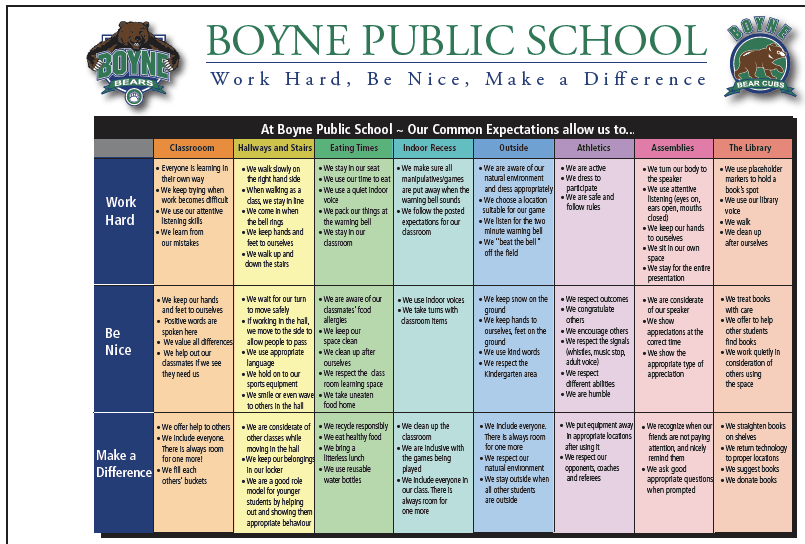
When I moved on and had the opportunity to open a new school I was not going to have a repeat of this.  As I have discussed in previous blogs, it was the use of our school mantra, “Work Hard, Be Nice, Make a Difference’ that provided us with the rationale, and purpose behind our decisions.

We were only going to do three.  If the School Council wanted to organize an event for charity they were welcomed to do this, as it was their initiative.  In my time at the school, our council only did events to supplement the finances of the school.  The school itself, however was only going to do three in a year and they were going to connect directly to our mantra.

And the three we were going to do would be done in a spectacular fashion.  We involved the entire community, and all classrooms because they were special events done one each term.

The three events were organized as this:

One event that was connected to the mantra section, ‘Work Hard’.

One that was ‘Be Nice’ and a third, ‘Make a Difference’.

It is easy to see how our partners in the charitable organizations could work with these descriptors and as a school it was another way for us to connect with students and families the importance of the wording in our mantra.

For example, the first major event in the year was right near the beginning and was done under the description of ‘Work Hard’.  In my time at the school this event has been the Terry Fox Run/Walk for cancer research.  Students learned all about Terry’s story through the additional lens of ‘Work Hard’. As an entire school event we were able to incorporate assemblies, classroom lessons and incentives while students new to us learned about the importance of working hard.  Senior students were partnered with our youngest students and our entire community was able to witness our students dressed in their red and white to bring awareness to this cause.

Senior Students Participating in our Terry Fox Event with Little Buddies

We would have another event in the middle of the year targeting a different charity tied to our mantra piece of ‘Be Nice’ and a third and final one at the end of the year to ‘make a difference’.

In my final year at the school:

Work Hard…Terry Fox Run/Walk for Cancer Research, 

Be Nice … the Halton Learning Foundation to support students and families in our own community, and

Make a Difference, Jump Rope for Heart for the Ontario Heart and Stroke Foundation

Each year we would have what is called a School Directions Meeting to review with staff the three events we held and what should/could be done for the following year. 

We felt this meeting process was transparent and it was open to all staff.  We invited all staff to attend and share their ideas.  As the meeting was advertised well in advance staff knew they were coming to participate in a process to select our three events for the following year.  Staff were able to participate in a facilitated discussion and the problem solving and selecting that would need to occur in order for us to come down to our final three.  This was an opportunity for me to share with staff how to facilitate this kind of discussion where a decision was needed to be made while valuing differing view points. Every year we had changes and over the course of the time the school has been in operation a wide variety of charitable organizations have been supported by staff, students and families.

This process also allowed us to have something in place when an idea or need was brought to us in the middle of the year.  Also as new staff members were hired, they brought ideas from previous schools and wanted to get something up and running in their new location.  We were able to describe our School Directions Meeting and that a process was in place.  Remember, process is your friend!

If a community member suggested a charity event, or donation activity for the school we were able to provide the same explanation and offer them the opportunity to provide us with materials to be shared.  Or, they could approach the School Council at a regular meeting to share.

If a cold call came into the office from the hard working people that work with local charities we were able to provide them with an answer right away and the process to provide them hope that the answer of yes may come in the future.  Many organizations appreciated our honesty and transparency and congratulated us on having something connected to our school mantra that made sense. 

Connecting your school, staff, students and families to charitable organizations by holding school events is a great way to showcase your school and illustrate to students that we live in a time when those that are able should assist those in need.  The individual stories of the families in your community are varied. Striking a balance is a difficult task.

Here is another ‘Interesting Idea’ of how you can use your school mantra to assist you with your communication and decision making in this area.

Starting a Movement

Interesting Ideas

I wanted to do something slightly different this week in my blog.  I want to promote a book and illustrate how this books aligns with the important work we did at our school in regards to building and maintaining our positive school culture for staff, students and families.

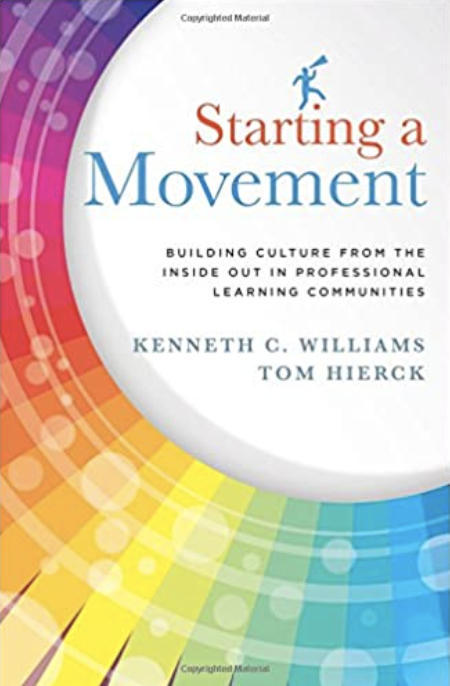
The book is Starting a Movement: Building Culture From The Inside Out in Professional Learning Communities by Kenneth C. Williams and Tom Hierck.  It was published in 2015 by Solution Tree Press and I highly recommend it to the readers of this blog.

The book delivers on its promise, printed on the back cover,

“Educators will:

  • Learn to express, clarify, and align their beliefs so that they are meaningful to teachers, staff, and other stakeholders
  • Create maximum buy-in among all members of the school community
  • Use the authors’ authentic alignment model to help keep their actions aligned to their schools’ mission and vision
  • Reinforce the researched, results proven PLC within their school culture”

It is time for you to take a close look at your school’s mission statement.  If it is working for you and you feel that it is well established, then at least look at the benefits of working with staff, students and the community to develop a school mantra.  This book with help with this process.  Your leadership will receive a major positive boost by doing this important work with your school.  The outcome of this work will impact many aspects of your school culture.

Our school started in September of 2015 and the book was published the same year.  I did not have a copy of the book prior to the school opening so it is after the fact that I noticed the connections. 

Prior to the school opening I had already used the saying “Work Hard, Be Nice, Make a Difference’ at other schools where I had been the principal.  Those other schools had a mission statement, created before my arrival.  So like many of you, I inherited a mission statement. There is an interesting discussion in the book about existing school mission statements and if they are known, utilized, understood or believed.  This particular section of the book will allow you to have a really critical look at your school’s mission statement.  

I didn’t realize it at the time, but by adding that saying into those schools on top of the mission statement, I was doing something that the authors share as a really positive action.  And it is not just the saying itself, it is the process and the actions taken in order to develop the saying.  Most importantly it is what  you do with the saying once established.  Don’t allow it to simply be writing on the letterhead.

Now is the time to reexamine your mission statement and the authors provide a process for doing just that. 

Although I did not have a copy of the book, I feel I had something better in place prior to the school opening and that was the guidance and mentorship and friendship of one of the authors, Tom Hierck.  With Work Hard, Be Nice, Make a Difference established in my mind to share with staff I had long conversations with Tom about bringing something ready made or developing it with the staff in the first year of the school.  I was put in a tough spot in a sense because the school needed to exist on line, on paper and in communication with the community prior to the bricks and mortar being in place.  The school officially started without staff in a sense. The school also opened under teacher sanctions and I was not able to have access to the staff to do this planning work.  

The saying was discussed with staff, and the rationale provided.  I started to use the phrase when visiting the students that would become Boyne students.  From the first time I met students, they heard, ‘Work Hard, Be Nice, Make a Difference’.  At parent evenings prior to school construction, families were meeting me, learning about my vision and plans, and hearing, ‘Work Hard, Be Nice, Make a Difference’. In a presentation for prospective staff interested in beginning this new school journey with me, they heard, ‘Work Hard, Be Nice, Make a Difference’. 

In all honesty it would have been difficult if staff were not in agreement or if they wanted to develop something right from the start.  It would have been a hard conversation for someone to speak up and say we should have something new that I had not used before.  I believe I was open and transparent in that work, and have come to understand through their acceptance, adoption and love for our saying that they are happy with the results.  Students and families continue to comment positively as well.

So for this blog I will be sharing key quotes from an important chapter in the book and reflecting on the quote with practical, real life examples of the work in action.

I have been using the term ‘saying’ and ‘mission statement’ in the first part of this blog. In fact what we have according to the authors is a school mantra. ‘Work Hard, Be Nice and Make a Difference’ is not a mission statement but in fact a mantra based on our mission, vision, values and goals.  It is longer in length than Williams and Hierck would suggest for a mantra but I’ll get to that later.

I want to introduce you to Chapter 3 in the book, entitled Exploring: The Why

‘the Why, is the process of examining your fundamental purpose and core beliefs.  Your goal is to capture the essence of your school’s mission in a guiding mantra to help strengthen that mission’

Starting a Movement: Building Culture From The Inside Out in Professional Learning Communities by Kenneth C. Williams and Tom Hierck (p.55)

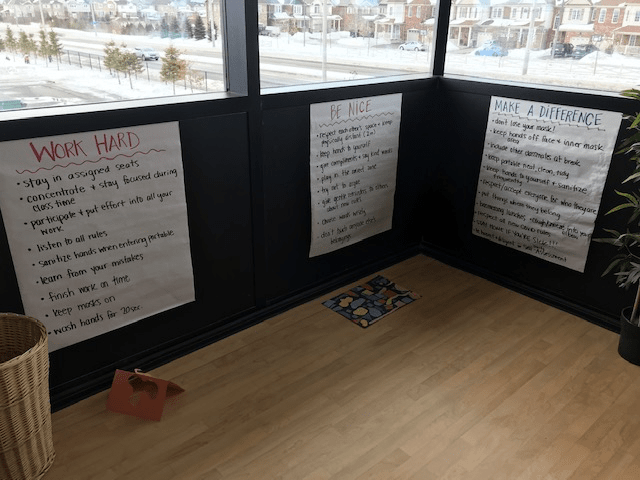
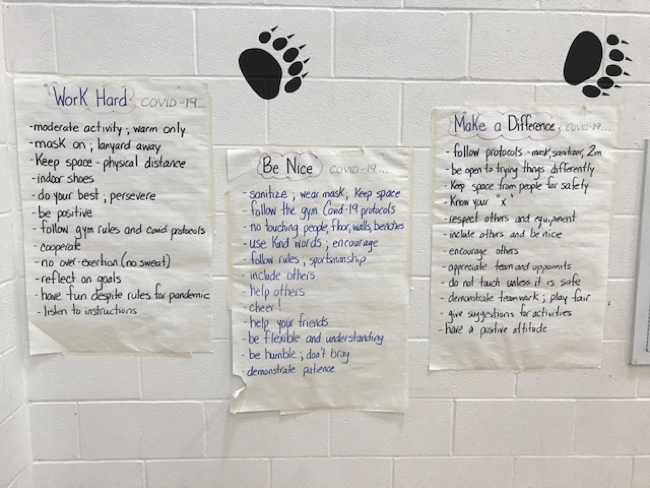
All the things we do at the school connect to our mantra.  Our commitments to each other come from these three statements.  Our classrooms begin the year by using Significant 72 (a previous blog) and developing with students how we are going to be a community by illustrating working hard, being nice and making a difference for ourselves and others.

Consider your existing school mission statement…

‘We propose taking one small and powerful additional step in this process: extract a non-negotiable ideal and distill it into a three to five work expression known as your guiding school mantra. Develop a mantra that captures the essence of your school’s mission in a concise and repeatable way.’

Starting a Movement: Building Culture From The Inside Out in Professional Learning Communities by Kenneth C. Williams and Tom Hierck (p.62)

So all this time I may have felt we had our school mission statement when in fact we had our school mantra. It is longer than the 3-5 word suggestion, however its simplicity makes it stick.  The three aspects of the mantra allow us to use each part separately and all together.  I still see it as concise and definitely repeatable.

‘Schools should identify the fundamental purpose, then use that purpose as the lens through which to guide decisions. We know it works for some schools, but often the outcome is a product; the mission statement.  We rarely see a unifying force that empowers educators to examine, clarify, and align every aspect of the school.’

Starting a Movement: Building Culture From The Inside Out in Professional Learning Communities by Kenneth C. Williams and Tom Hierck (p.56)

‘Because the typical mission statement rarely serves as a guide to inform your choices, behaviours, and decisions, it is, in essence, ‘fluff’. When you consider the time spent creating a mission statement versus the fact that its ideals seldom trickle down to the daily work of teachers and leaders, it’s easy to understand the cynicism that arises.’

Starting a Movement: Building Culture From The Inside Out in Professional Learning Communities by Kenneth C. Williams and Tom Hierck (p.58)

There are times when we need to support students and some of the choices they make.  We would use our mantra continually. Some students need a reminder conversation from staff about how we were going to work together and how the adults can support them with their lagging skills.  Their troubles began with a situation where they were not working hard or not being nice.  A conversation out of class or in the office area would start there.  They are removed from their peers in order to get support because they are not working hard or not being nice.  Now that we have that as a starting point, what are we going to do to go back to the situation and make a difference for yourself and others and how can we help you?

‘Yet in almost every instance when we ask staff members to identify agreed-on ideals around which the entire school rallies, to identify a non-negotiable idea that guides the daily work of their school, to state the agreed-on purpose that serves to both compass and guide for every important decision made on campus, we almost never see agreement on what that guide is’.

Starting a Movement: Building Culture From The Inside Out in Professional Learning Communities by Kenneth C. Williams and Tom Hierck (p.56-57)

‘the conversation turns to the school mission statement-the statement that everyone knows exists but no one can connect to the daily work of teaching, learning, and leading’

Starting a Movement: Building Culture From The Inside Out in Professional Learning Communities by Kenneth C. Williams and Tom Hierck (p.57)

‘The stated mission should permeate every aspect fo school life.  It should serve as your school’s rallying cry and ultimate litmus test to determine what is best for improved student learning; you should not view it as an opportunity for positive public relations that eventually fades into obscurity’

Starting a Movement: Building Culture From The Inside Out in Professional Learning Communities by Kenneth C. Williams and Tom Hierck (p.57)

Every classroom, and every student is involved in the process at the start of the year and then monthly check ins (Significant 72) about our commitments to each other.  Kindergarten students are able to share with staff what it looks like and sounds like to work hard and be nice.  During nutrition breaks when we are eating in our classrooms prior to going outside, grade eight students are able to share what this non instructional time looks like using ‘Work Hard, Be Nice, Make a Difference’.  Our School Council of parents are able to create their meeting norms using ‘Work Hard’ ‘Be Nice’, ‘Make a Difference’. In the gymnasium, students are able to articulate the mantra. 

An interesting aspect of the chapter comes later when Williams and Hierck offer a caution. They guide you and want you to avoid something they call ’t-shirting’. 

‘It means you place more emphasis on slogans for t-shirts, lanyards, coffee mugs, bumper stickers, and banners than on how your statements actually guide instructional and assessment practices and interventions.  In our experience, few can articulate how their statement explicitly manifests itself in daily work’

Starting a Movement: Building Culture From The Inside Out in Professional Learning Communities by Kenneth C. Williams and Tom Hierck (p.59)

To be honest we have t-shirts for staff, and the mantra is on the walls, but it is so much more than wallpaper.  Our interventions program named WIN (Whatever I Need) is driven by making a difference, it is in Significant 72 (previous blog), establishing our agreements (previous blog), in report cards learning skills(previous blog), in our graduation ceremony(previous blog), in Kindergarten celebrations, and in our fundraising initiatives.  An event does not occur, a report is not written without using the lens of our mantra. 

We got this!

‘Ideally, your mission statement would permeate everything you do at school – embedded in your school’s culture, committed to memory, modelled, and intrinsic to daily life’

Starting a Movement: Building Culture From The Inside Out in Professional Learning Communities by Kenneth C. Williams and Tom Hierck (p.62)

‘It can be a short, energy-infused statement around which your school organizes; it defines what you are and guides all internal decisions.  Further, it’s a powerful chant that everyone inside your school can instantly understand, recognize, and repeat-a constant reminder of what you can expect from each other.’

Starting a Movement: Building Culture From The Inside Out in Professional Learning Communities by Kenneth C. Williams and Tom Hierck (p.62)

At assemblies I would often begin the mantra and only have to say ‘Work Hard’ before the students would complete the phrase in unison.  We have yearly student and parent surveys and we are able to insert our own questions at the end in order to get specific data or feedback.  We have inserted the statement and asked participants in the survey to complete the phrase, ‘Work Hard, Be Nice, ….”  98% of our students completing the survey were able to answer correctly, our parent responses were not quite as high but still a large majority or our parent community were aware of our mantra.

Hopefully, I have been able to share with you the power of having a school mantra.  Not only the development process is important to the school culture, but the continuation of a positive school culture is predicated on having common expectations that everyone, like Williams and Hierck write, ‘instantly understand, recognize, and repeat-a constant reminder of what you can expect from each other’ (p. 62)

So I leave you with two thoughts.  The first, do your staff, students and community know your mission statement?  The authors make a terrific point,

“We often ask our workshop participants to share their schools’ mission statements from memory.  What follows is often a complete loss of eye contact, uncomfortable shifting in chairs, the sudden emergency cell phone call, the impromptu bathroom break, the nervous laughter-all clear signs that people don’t know’

Starting a Movement: Building Culture From The Inside Out in Professional Learning Communities by Kenneth C. Williams and Tom Hierck (p.57)

And finally, check out Starting a Movement: Building Culture From The Inside Out in Professional Learning Communities by Kenneth C. Williams and Tom Hierck. On page 65 look at ‘Creating Your Guiding School Mantra: The Tip of the Iceberg’ 

Do this exercise!

Re-culture if it is needed, rebrand with a mantra. It is so beneficial for students, staff, families and for your leadership.

Cell Phones at School

One School’s Story

Interesting Ideas

We had a problem with cell phones at our school!  

I want to share one school’s story on how we worked with students, staff and families to address the issue.  

I will start by saying we are an elementary school so our solutions are based on one thousand plus students in Kindergarten to grade 8. 

While walking in the hallway it was not uncommon to see someone walking with their head down and staring into a screen.  Or walking past a classroom and glancing inside to see someone in a group of students with their heads in their phones. Or off to the side of the room while everyone was working, on their own, on their phone.  And in all of these examples I am speaking about the adults in the building. Adults on their phones when working with/for students.  Not okay.

How we discussed this and solved this as a staff professionally and respectfully is going to be the topic of a future blog.  I’m sharing this as a bit of a tease because in this blog I want to share how we encouraged proper technology use by students in our school.

We were a BYOD school (Bring Your Own Device).  This was especially important in our first few years when our student population was high and our number of school owned devices was still low.  Senior students were invited to bring their own device to the school to use in their classrooms.  It was not a requirement.  We made sure families understood we always had technology available for student use.  We did not want students going home and saying they had to have technology for school!

Letting students use their own device did really help everyone at the beginning.  Everyone likes using their own devices for comfort and ease.  We know how to navigate our own tools and where we keep files and work.  We were confident that done properly, and with student voice and family input we could create a process that would work.  We wanted it to work, technology is an important tool and part of the learning process includes how students use technology effectively, properly and respectfully.

We followed all the board issued mandates with families about loss, theft and damage.  We gathered all the required paperwork and then started on our journey with students to formulate how this was all going to be operationalized.

Staff created schedules in order to share the technology we had on hand.  Most importantly the staff developed an understanding that the technology is a tool to be used by students when needed and really limited the amount of time where every child needed a device at the same time. We have moved way past a time when all students are using the same program at the same time, in the same way and instead allow students’ choice in how they demonstrate their learning. With a heavy emphasis on differentiated instruction and student choice, gone are the days when you would see the entire class in a computer lab or each child at a workstation.  Computers, and tablets are in the classroom available to students to use as needed.  Also available to students is their own device if required.  So how do we monitor the proper use of these powerful tools?

I can remember very early in my administration career, when cell phones were just becoming a thing you would see at school.  They were considered a distraction, a nuisance and we banned them.  We could not understand why any elementary student would need a phone at school if there were pay phones and office phones.

We now have a better understanding of the power of the devices in student hands.  It is not the cell phone itself that is the issue, it is what the cell phone is being used to do.  Parents provide or allow cell phones for their children for many reasons. It is important for our families to know that when at school the cell phone is being used in a responsible and respectful way. Cell phones are a wonderful tool that when used well, and used properly can and should be a learning tool that students learn to use appropriately. They are not going away.

Listening to student voice was always a key strategy in our school and how we were going to use technology in our school was another opportunity to hear from students.  Using our school motto of ‘Work Hard, Be Nice, Make a Difference’ we developed our agreements.  These were developed with our classes, shared with everyone and are reinforced with students multiple times in the year (Significant 72 opportunity).  You will see that students did come up with agreements around non-instructional time as well as instructional time. A copy of the poster that hangs in each room is shared with you here.

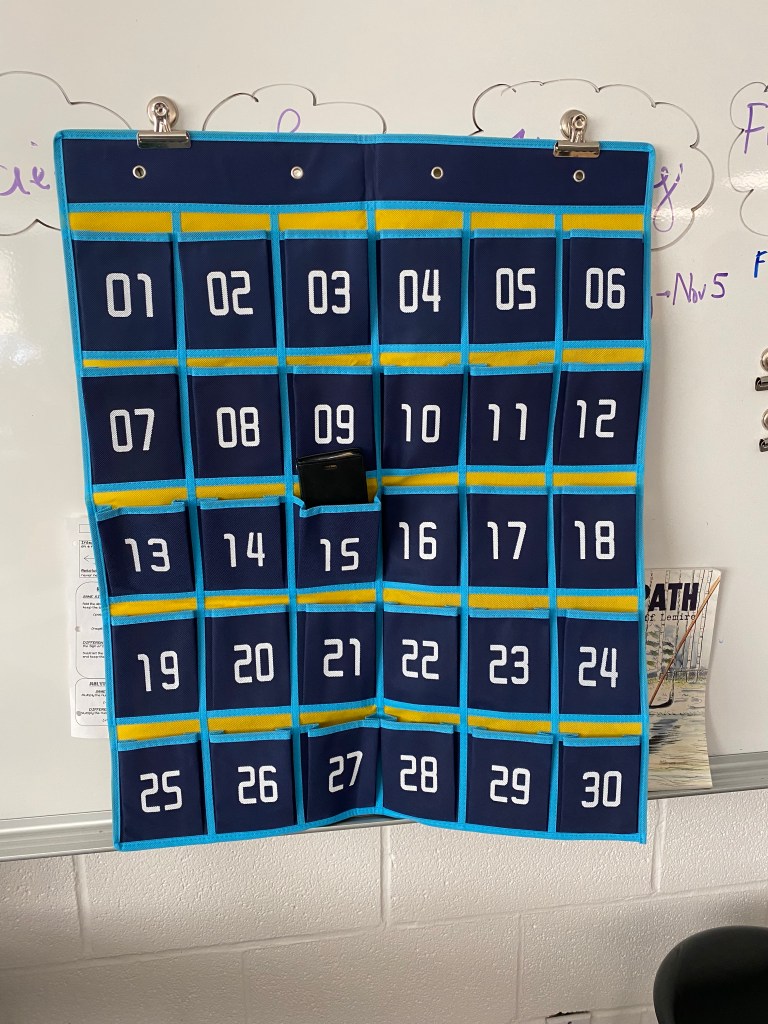
We noticed on line that schools could purchase locking mini cabinets that could be installed in classrooms so schools could secure cell phones when students entered a classroom. As an elementary school we went ‘low tech’ and purchased for each classroom a numbered pocket chart.  Students were assigned a number based on their class list and when students entered the room for their class period they were asked to place their cell phones in their corresponding pocket.  The pocket chart was hung in a safe area of the classroom, i.e., a corner behind the teacher’s desk.  There, the cell phone would remain until the end of class or until the teacher had a section of the lesson where students could use their own device.  One big issue this solved was that washroom visits, quick trips to the hallway or back to their lockers did not include checking in with their cell phone.  At the end of class the teachers would monitor the retrieval of the cell phones based on numbers, seat locations etc.

If they did not place a cell phone in the pocket chart it was because of one of three reasons

  1. They do not have a cell phone, or they did not bring it to school that day
  2. Their cell phone was not brought to class and instead is locked safely in their locker
  3. It is in their bag, or backpack in class and will not be seen or brought out during the class, they are planning on using the technology provided within the class

When teachers provided class time for student work that could involve the use of technology a ‘Tech Time’ poster was placed on the board at the front of the class and announced to the class.  At this point students could retrieve their cell phones and use them if they wished. A simple visual, you see the sign, it is okay to use the technology in the room including your own device.

We did not have any difficulties with this process.  Students were respectful of others’ property and I believe this was all because of the preliminary work and relationship building done by our staff before starting, during lessons and discussed fairly regularly.  As well, students were part of the process to develop the plan.

What did we do if the agreements were not followed?

If teachers saw a student breaking an agreement they would ask for the cell phone and keep it with them until the end of class.  At the end of class they would ask a colleague to assist them with any responsibilities they may have so they could have time with the student.  A conversation would take place putting the onus on the student to talk about the commitment and why the phone was taken.  After a conversation the student had their phone returned.

The expectations were reinforced during the conversation and it was shared that the next time would involve a learning exercise done on their free time.  Students were ask to write or assisted in writing, using the common expectations in order to explain what they had done, what they should have done and what they would do next time (simple three paragraphs).  Depending on the situation, the teacher would date this and keep it on file or decide to have the assignment taken home by the child and have it signed by a parent.  

The parent would be reading something written by their child about the expectations in the classroom.  It was not a formal letter or email from the teacher or school. Written from the child’s perspective, it showed understanding of the expectations and always received great support from the family.  

And finally, if necessary, if difficulties still remained the teacher would give the cell phone to me and I would place it in the school safe.  We asked the child to explain to their parent why this had to occur and I would return the cell phone once I was able to have a phone call or face to face meeting with the parent.  At the end of the day I would contact the families so they were aware we had their personal property in our school safe.  Often parents would drive to the school in order to pick up their child at the end of the day and this provided an opportunity for parent, child and myself to meet.  These conversations were easy to facilitate because the child knew the expectations.  They knew the order of the consequences, and had already done a parent letter. In six years at the school we did not have a child repeat the cell phone in the safe process.

Parents were appreciative because it was all carried out with respect and transparency.  We never shamed the child because we all wanted the same outcome.  We want our students to use the technology.  The parents and the school just want the technology used in the proper way. Students are not sneaking glances at their phone to do school research. 

Once parents found out how the child was using the phone in the school we were able to have a great conversation about the use of technology in schools.  The conversation often turned to why this elementary aged child had the phone to begin with and that the school did have the  ability to supply technology.

Over time we purchased enough technology for student use that the need to bring in their own device was not as necessary, and we remained a BYOD school.  Students still like to bring in their cell phones.  We are okay with that, because of the learning that is involved in creating our agreements as a community and we value the importance of understanding the proper use of technology while at school.  A key lesson even for the adults!

Teacher Evaluation=Leadership

Interesting Ideas

I wanted to write this week about the Teacher Performance Appraisal (TPA) process and share with a you a few Interesting Ideas as you make your way through your evaluations this year.  

No matter where you are located or what your process is for teacher evaluation in your district I imagine we share enough similarities that these Interesting Ideas should resonate with you.

Based on the size of your school and the cycle that is employed there could be years where you have many evaluations to carry out.  In my time there were extremely busy years and years where the cycle meant there were less.  Now, always being in large schools still meant that even quieter years still came with many teacher evaluations. It would be a shame if your teachers did not get the best from the process or from you during a year that there were many evaluations. 

While you may have countless evaluations to carry out, for the experienced teacher, they are going through the process once every 5 years in Ontario. Administrators transfer schools and teachers move schools, therefore it is most likely that the evaluations you will be doing this year are the only time you will conduct the evaluation process with those individual teachers. For that reason I always tried to put time and energy into the process regardless of the number I needed to carry out in a year.

In order to motivate me to do the best that I could do for my teachers, my self talk revolved around this need to do it well since the process is once every five year.  I wanted to give the evaluation my full attention and for the teacher create a supportive process that would strengthen their teaching and our relationship.

There is a document for you to consider. Supporting the Ontario Leadership Strategy: Principals Want to Know, Issue #19 from April of 2012. That particular issue was called Annual Learning Plans and Teacher Performance Appraisal. It is now dated in a sense, but contains lots of still relevant information on this topic.

What could be considered a managerial task by some, really is a leadership opportunity of us all. In the document a question is raised, ‘How can I augment the learning culture of my school by effectively engaging teachers in their Annual Learning Plans (ALP) and Teacher Performance Appraisal (TPA)?” 

What a great question.

The answer is provided in the section of the document titled ‘Five Tips for Success’

  1. Embed learning focused conversations in your daily interactions with teachers
  2. Collaborate with teachers
  3. Build coherence between ALP/TPA and other school, board and ministry initiatives and priorities
  4. Align professional learning and resources with teachers’ ALPs (a huge part of my previous blog)

And, finally the focus of this blog

5)   Use the TPA as a growth-oriented opportunity

Remember, for each teacher it is once every five years!

The TPA provides you with an opportunity to really dig deep, to ask important questions and provide the support requested from your teachers.  All along you have been having conversations, providing support, being in classrooms, and seeing teachers in action daily. The TPA process allows you to slow down (as much as an administrator can) and really bring value to the experience.  This formal process allows you to peel back some layers and go much deeper.

First off I go to the teachers’ classroom.  I go to their environment.  I don’t conduct the meetings in my office.  In their classroom is where they make the magic, it is where all their resources and materials are kept.  Comfort will be increased if I go to them.

I ask permission to review their professional resources on my time, not their time.  If they can leave a ‘resource section’ of a table or desk for me I can come and go and pick up a binder or notebook to look at on my own time, and not waste valuable discussion time flipping through their resources with them present.  I should be able to tell what is happening in practice when reviewing each resource!  Their parent communication binder, their short and long range plans, their connections to the curriculum, their assessment and evaluation binder, their occasional teacher resource binder etc, etc.  If I have questions, I place the question on a post it note and discuss it with the teacher when we are together.  I can take my time, look deeply at the work they are doing, and save them time by not having to explain what in many cases is self explanatory.

The same review process is used for online resources.  I ask permission for things to be shared with me so I can review and take notes during times when we are not together.

When we do get together we can have a targeted discussion about their annual learning plan, what I saw in their resources, the notes from my classroom observation and provide support and advice that is forward thinking feedback. Feed forward, not feed back!

The most important outcomes for our time together include acknowledging the great work they are doing; filling their bucket; discussing their goals; and asking how I can help. 

Now is an important time to clarify this is a completely different process if the teacher is struggling and may receive an unsatisfactory evaluation. I will say that if you are waiting for the formal TPA process in order to get into the classroom to coach, model, support and have difficult conversations about their commitment or performance then you are not doing what is expected of you. You cannot wait for those conversations, the students in those classes and the families of those students are trusting in you that a qualified dedicated professional is working each day.

The comments I have been making about the collaborative TPA process with administration and teacher is for the large percentage of our educators that are doing wonderful work.

The 5 domains in the Ontario Teacher Performance Appraisal come from the Ontario College of Teachers’ Standards of Practice for the Teaching Profession.  The five domains are:

  • Commitment to Students and Student Learning
  • Professional Knowledge
  • Professional Practice
  • Leadership in Learning Communities and
  • Ongoing Professional Learning

After the formal classroom visit(s) I view our post observation discussion as having two areas of focus.  The first area of focus revolves around their view of the lesson, their comments, corrections, next steps etc as well as my impressions.  This conversation revolves around the first three domains listed above.  While viewing the teacher working with students in a classroom an administrator is able to find evidence of commitment to students and student learning, professional knowledge and practice.  Goal setting and next steps are generated based on this classroom aspect and as an administrator I provide my support for the growth of the teacher in this regard.

The second area of focus stems from the final two domains that cannot be gleaned from a classroom visit, but instead, require a rich conversation with lots of questions.  Leadership in Learning Communities and Ongoing Professional Learning are not seen during a classroom visit.  It is during this second part of the conversation that the relationship is strengthened, support is provided for areas identified, and you really get to know your staff members’ goals, dreams and wishes.  This conversation has been an important beginning conversation for those staff members that have left the classroom to move towards positions at a board, or system level and/or to move into the administration role.

The Ontario College of Teachers have many amazing resources and documents.  One in particular that has assisted me with these final two domains of the TPA process is the OCT Professional Learning Framework for the Teaching Profession June 2016.  In the middle of this resource is a placemat about the Conceptual Framework for Ongoing Professional Learning.  Using this placemat as the basis for our conversation, together we are able to see potential pathways for more learning.  Opportunities such as: Community and Social Justice Experiences, Professional Inquiry, Curriculum Design, Development and Assessment, Research and Scholarship provide a potential road map of considerations for your teachers.

The entire Teacher Performance Appraisal process is a tremendous opportunity for you to appreciate and acknowledge your teachers.  It is a chance to bucket fill and provide a document that they can magnet. on their refrigerator to share with loved ones.  

Five years!  They are deserving of positive comments that for a moment in time make all the hard work worthwhile.

Think of the conversations you can have. Think what you can learn about your staffs’ fabulous teaching practices.  Think about how you can motivate and appreciate.  Think about how you can influence. Think about how you can direct and give support.

It does take work on your part.  Yes, there are so many other things that need to be done with your time.  It is a necessary process, a management piece that can have a huge impact on your relationships and culture.  Take a deep breath, convince yourself that it is an important aspect that requires your best attention.  Done well, it provides so many benefits.

References (Placemat)

Ontario College of Teachers. (2006). The ethical standards for the teaching profession. Toronto, ON: Author. 

Ontario College of Teachers. (2006). The standards of practice for the teaching profession. Toronto, ON: Author. 

RRO 176/10. Teachers’ Qualifications Regulation of the Ontario College of Teachers Act

References (Supporting the Ontario Leadership Strategy)

Robinson, Viviane (2007). The impact of leadership on student  outcomes: Making sense of the evidence. Melbourne: Australian  Council for Educational Research  

Stronge, J. and P. Tucker (2003). Handbook on Teacher Evaluation:  Assessing and Improving Performance. Eye on Education  Publications  

© Queens Printer for Ontario, 2010 ISSN # 1923-9653 (Online)

Never Stop Being A Teacher

Interesting Ideas

This week I wanted to share with you some resource ideas and a simple point for you to consider that will assist you with your work building climate and culture in your school.  It is a leadership move that will aid your teachers, benefit your students and give you a huge pat on the back for a job well done.

Never stop being a teacher.  It sounds simple enough, however we can often get swallowed up by the management aspects of the administrator role and lose touch with our past.  And in the past you were a great teacher.  Not all great teachers become administrators, but all administrators are/were great teachers.

It is really satisfying as a leader to see your influence find its way into the classroom.  No longer being a teacher in the classroom is one of the most difficult aspects to give up when moving into an administrator role, but it doesn’t have to be.  It is still a wonderful feeling to know you never stop being a teacher and you can continue to grow and develop your staff long after you have left the classroom.

I am not speaking about interacting with students.  It is obvious that we continue to get into classrooms, support students, read with them, participate in their group work and get down on the carpet with our youngest learners.  I am writing this week about being a teacher to staff.

Every opportunity I had to work with staff during staff meetings, learning meetings, divisional meetings, professional activity days etc I made sure I was modelling activities that can be used in the classroom by the teachers with their students.  Each piece of content that needed to be shared, presented or read I would attach the ‘product’ or outcome of the content with a ‘process’ or teaching strategy to interact with the content.

Any time you have your staff in front of you it is an opportunity for you to model an activity while you present the content.  I would name the activity or process, I would write it on a poster or in a digital presentation and have the staff acquire the needed information by activating and applying a process.  My agenda for the meetings would always include two columns, one column for the content and one column for the activity or process I was going to share.  

There are many famous facilitation techniques such as ‘think, pair share’, ‘3A’s plus 1’ ‘Just Like Me’, ‘3,2,1’ but many more out there that can be used with your staff so they are getting the content of the meeting and also a collaborative activity that they can use with their students.  I also find time at the end of the activity to have staff turn and talk with others about how they would use the strategy, how they would adapt it for the age and stage of their children and in which content areas.  Could they give an example of how they will use the strategy in the coming days?

As a leader, it is incredibly gratifying to find evidence of the activity done at a meeting in a classroom with students later in the week.  Or having staff share with you, ‘hey, I used that strategy you showed us on Monday with my students today’

While teaching the principal qualification course I make sure I deliver the content in a variety of ways and each time we have a grouping activity I share with the candidates a process or protocol while interacting with the content.  When the activity is done we speak about where you would use the process in the future and they begin to understand that this modelling is important with staff, during parent council meetings, learning days etc.  

Never, ever miss the opportunity to share great instructional practices when you are learning with your staff.  It pays huge dividends when you inject some life into your meetings with effective, interactive learning strategies that can be taken away and used with students.

You can find lots of great resources on group activities in categories such as:  Activities for Getting Started, Activities for Information Processing, Activities for Generating Ideas, Strategies for Dialogue and Discussion  I have found the work of Bruce Wellman, Laura Lipton, to be very helpful with lots of ideas, activities and protocols to use.  A book that has caught my attention and has many ideas for facilitating is Crafting Your Message: Tips and Tricks for Educators to Deliver Perfect Presentations by Tammy Heflebower with Jan K. Hoegh.  It is available through Solution Tree.  Send me a message if you need any assistance locating the resource.

As always I love hearing from you when you have taken one of my “Interesting Ideas” and made it your own.  I’m honoured that you continue to read, use some of the ideas and then let me know.  Keep the messages coming.

Build School Culture With Reporting – Learning Skills

Interesting Ideas

While reading and signing hundreds of reports cards is not always the most pleasurable task for an administrator, reading excellent report cards can and will restore your faith in what happens when excellent educators work their magic with students and families.

I remember spending time in Australia and seeing an elementary report card.  The entire first page was a photograph of the child and organizational information like age, grade, teacher name and school.  On the back side of this first page was a section on work habits and goal setting, prior to page three and four which had all the subject grades and comments.  I always felt this was such a great way to highlight the student, emphasize them as an individual and illustrate to families and the child the importance of their work habits and life skills before showing grades in subject areas.

In Ontario we call this work habits section of the report card “learning skills” and it is also prominently displayed front and centre.  It is a great opportunity for thoughtful, talented educators to illustrate they care for and understand the child and think of them as a unique individual with talents and skills that are noticed and appreciated.  As a leader, emphasizing the importance of assessing and commenting on learning skills will aid in your desire to build and maintain a wonderful school climate.

Assessment is provided in six different learning skills on the report: responsibility, organization, independent work, collaboration, initiative and self regulation.  These six areas of development are so key to student learning that they are placed at the beginning of the report in order to be read first and understood prior to looking at subject grades and comments.  It is not uncommon to hear families say, it is the only section of the report card they truly read and discuss with their child.

Learning skills and work habits are not included in subject grades unless there is a clear link to the achievement of curriculum expectations.  Achievement in subject content areas is based on the knowledge/skills categories and could be the topic of an entire blog as its own discussion.  Let’s just say I am old enough to remember having items such as organization, and responsibility included in my grades and as a teacher including marks for behaviours and skills unrelated to subject content.  I am so glad we now see the error in our ways and keep these two aspects of evaluation separated and discussed on their own as unique important sources of information.

One way to think of the evaluation of learning skills is to consider they are always work in progress.  We have a responsibility as educators to assess and assist!  Since these are life long skills, we should be constantly goal setting with students, helping them develop these traits in order to have full and productive lives.  Therefore we are assessing for and as learning based on the age and stage of the child.  Learning skills should never be consider assessment of learning.  It is never summative.  This work is never done.

If we are going to elevate the importance of these learning skills then students should receive explicit instruction and feedback about these skills.  Students should be involved in co-creating success criteria for each of these learning skills to know exactly what they mean and how they can recognize success for themselves in relation to these skills.  It all starts as a teacher’s responsibility to instruct and assess these skills, and to provide opportunities for students to demonstrate these skills in a context where students understand what is being assessed.  The criteria can be updated and revised into student friendly language as children are given tasks where peer and self assessment are utilized.  Continually working towards self assessment would be an important target in all classrooms.

It is essential to have both process and product assessment during classroom time.  While assessing a subject specific expectation integrate one or more of the learning skills into the assessment.  At the end of the assignment or task, students should receive feedback on both the subject expectations as well as the learning skills on the same rubric or assessment tool.

Setting and monitoring goals within these learning skills is therefore a key role for the teacher. Illustrating to students how this is done is an important focus during teaching and while conferencing with students.  There are numerous ways to create learning skill data for students to use: peer assessment, self assessment, rubrics, teacher observations, checklists, conferencing, descriptive feedback, rating scales (smiley faces)

There is great research on the importance of goal setting for students.  Setting personal goals and monitoring these goals while receiving feedback help students gain a greater understanding of who they are as a learner.  And isn’t that what is is all about?

As far as how the learning skills are written within the report, we have from the Growing Success Document

Teachers should strive to use language that parents will understand and should avoid language that simply repeats the wordings of the curriculum or the achievement chart. The comments should describe in overall terms what students know and can do and should provide parents with personalized, clear, precise, and meaningful feedback. 

~ Growing Success, p. 64

At our school we asked our staff to incorporate ‘Boyne’ language with specific examples of how and when the child demonstrate these skills.  Our school mantra was, “work hard, be nice, make a difference.”  Our staff were asked to connect this wording with the learning skills and make connections on how the child is illustrating our key school beliefs when they, for instance, ‘work hard’ on their organization, with an example that is unique to them.  It is easy to see how the six learning skills fit into our school mantra.  It was lovely to read about and hear parent’s comment about how their child was ‘making a difference’ through their behaviours in school.  

Does your school motto/mantra fit into your assessment of work habits or learning skills?  Build your school culture by including aspects of your mission and vision within your assessment comments.

We asked staff to make sure the comments were individualized with specific evidence.  Therefore the child could speak to the work being referenced or the family may be familiar with the task.  We want the use of the child’s name!  The comments should vary from student to student as they are all unique individuals and this is one part of the report card where that is abundantly clear.  Here is an opportunity to really show the family that you recognize their child as a unique individual with their own talents, needs and attributes.  It would drive me mad when I saw repeated comments used for numerous children in this section of the report.  Yes, a template is beneficial when you are writing numerous reports, but the goals, the activities, the examples and student voice in each must be differentiated.

It goes without saying that it is going to be written using asset language, positively phrased for all students highlighting what they can do, and not what they are not able to do (YET!).  There will be an opportunity to highlight goals for the remainder of the school year and this should be done in a positive, and confident of success manner.


Learning skills provide an excellent showcase for student voice.  And, if student voice is one of your hallmarks in your school,  you say you are going to incorporate student voice, what better place to show this than in the assessment of learning skills? Considering the age and stage of the learners, student voice should be included in the learning skills.  Use quotation marks and have the exact words of the child sharing with their families what they are working towards for the next term.  Making our goals public not only increase our chances of success because they are known, it also provides the opportunity for others to get involved in helping us. (there you go, parent involvement!)

Even if you don’t include direct quotes from the student’s voice in regards to their goals, the making of an action plan is an important growth opportunity and having a student work on it in collaboration with the teacher is another wonderful opportunity to strengthen this important relationship.  Students should be assisted with identifying their own strengths and needs as a learner and how to select the strategies that will assist them.  Throughout the term there should be opportunities for monitoring and discussion.  All of this process can be captured in the learning skills comments and/or shared with families during conferencing.

A comment could be as clear as:  (name) has identified an important goal in the area of independent work, she stated, ‘…….’  This is a wonderful goal for (name) and she will be supported with….in order to reach her goals

The next steps within the learning skills comment can focus on the child’s goals for next term, the teacher’s professional judgment on what is required for future success but must focus on the concept that learning skills are not an after thought, they are continually taught and students are provided with lots of opportunities to know and understand them. Therefore next steps indicate to families that there will be continued attention given to the development of learning skills, and the strategies that will be taught, practiced, and monitored 

So much time is invested in the creation, development, and writing of report cards. Work with your staff to create a document that every one can be proud of, that further supports your school messaging but most importantly a document that will truly benefit your students and their families.

Getting Things Done

Interesting Ideas

I wanted to share with you training that I have received that made a profound difference in both my personal and professional life.  I truly wish I had done this training much earlier in my career.  

We all want more hours in the day.  I think back to how inefficient I was at the beginning of my leadership journey and all the time and energy spent on just keeping myself organized.  I thought I had a good ‘system’ in place but every once in awhile I would miss deadlines, or miss opportunities for myself or my school.  The stress created by the volume of the work can, at times, be overwhelming. 

Getting Things Done (GTD) is training provided by Crucial Learning (formerly Vital Smarts).  I have provided the link to Getting Things Done at the end of this blog so you can investigate it more thoroughly.

In order to be transparent I will share that I am a licensed trainer with Crucial Learning and GTD is one of the programs that I can provide for individuals, teams and organizations.  I have trained countless individuals in the beauty of GTD in both virtual and face to face training sessions. It is training that has had a huge impact on me and feedback from participants has indicated to me it is a game changer.  I would not train with Crucial Learning if I did not believe in its benefits to others.  I welcome any inquiries about how we can get you and your team trained in this career changing, life changing program.

It is based on the New York Times bestseller, Getting Things Done: The Art of Stress-Free Productivity by David Allen.

For most of us we don’t need more things to do. The training is not about addition.  It is not about getting more things done, it is about efficiency and how to properly engage with the items that do take your time and create time pressure stress.  You will learn to work more effectively with all the inputs that come to you and not miss important items.  The training will free up your mind to allow it to do what it does best, be creative, problem solve, work on relationships, plan and dream. Your thoughts will be clearer when not trying to remember what needs to be done and therefore, decrease the stress of trying to continually keep your commitments straight.  A common training phrase is, ‘get it out of your head and into a trusted system” And the gold standard phrase that summarizes the training nicely is, ‘your mind is for having ideas not holding them.”

Want to get your inbox to zero? GTD

Do you use your calendar effectively? Does it contain the right items?   GTD

How many of your next steps rely on someone else to do something first before you can proceed? GTD

How many times do you realize that a situation came back and blew up because it was not handled well when first seen or heard?  GTD.  Learn to give items attention when they first show up so you don’t have to give way more attention to it later, when it blows up.

We all have our way of doing things, and some of these skills you may already be doing.   Guaranteed, you will learn additional tactics and the science behind why you should be changing some of your organizational habits.  You could have the best tools, applications and programs, but if not used well, they are just bright shiny objects and toys.  It is about the habits not the calendar, app or organizational tool.  Change your habits, change your behaviour, you don’t need a more sophisticated system. 

The best part of the training is that you are shown these new behaviours using your own life, and your current organizational system.  You are not working with a fictionalized individual. You use your calendar, your phone, your computer, and your own to do lists to learn important skills.  You are your own content.  It is training where I want to see people on their phones and on their devices!  You will walk away with your schedules, emails, lists and commitments on the path to a structure and clear organization that works for you and the skills to maintain it.

In the feedback I have received from graduates of the course they have identified some new key behaviours in their routine that have been the biggest blessing for them.  Learn more about these ideas.  

They include:

– Calendar first, then email in the morning. It is a way to avoid the newest and loudest because our tendency is to have something new arrive and make it our priority.

– Determine what items mean to you when they first arrive. We can only do 6 different things with the inputs that bombard us each moment of each day.  We can: File, Incubate, Trash, Delegate, Do Now, Do Soon

  • Set up a proper inbox (physical and electronic)

– Unsubscribe from unnecessary emails as soon as they are seen

– The 2 minute efficiency rule.  It takes less than 2 minutes to do, less time than to write it down or worse, try to remember to do it.

– Not one, large, unruly to do list.  Instead to do lists are organized by context. 

– Continuing to go through my email and make those decisions in the moment whether to unsubscribe, trash, or file. Commit to not reflag emails as unread.  

– A weekly review.  A scheduled meeting with myself to look forward to the next week and to go back and look at the week that just past.  Review your lists, clean up your lists, make sure nothing is dropped. 

And to conclude,

In my feedback method I invite participants to create an advertising blurb based on their experiences and ask permission to use their name within the organization.  My past participants are my best influencers for others in the organization.  Since this blog is going outside our internal organization I have removed the names. These are eight of my most current comments received and have not been edited.

“Peter I loved the online platform, which surprised me….I’m all zoomed out but this had so much participation and action, I felt engaged the whole time. What can be done to make all online learning work this way?”

“I thought I was a pretty organized person until I took GTD and then realized how much more efficient I could be with work and home life.  I have always believed in the saying “It might be hard, but it will be worth it” and tweaking and changing how I manage my “stuff” is game changing for me.  GTD is practical, hands on and truly for everyone. “

“By acknowledging that my brain is for having ideas not keeping them – the 2 min jobs that normally occupy my brain and stress me out are not going to anymore. They are happily going to be DONE and off my brain!!!-“

“This course addresses a really important aspect of our professional lives, our use of time. The GTD method is logical and can make a huge difference to people professionally as well as personally. “

“GTD allows one to continue to learn effective ways to utilize time.  The training embeds time to look at the effectiveness of our brains, the pitfalls that we encounter and then supports you with the steps to take to do things differently.”

“Getting things done is a toolkit of skills that helps you change your behaviour and use calendars, email and list management tools effectively.”

“I truly have enjoyed the GTD program and cannot believe the difference it already has made, helping to clear my mind by capturing thoughts.  My goal this summer is to dig a bit deeper into the program and also read the eBook.  I think the concept and “new lifestyle” will help me with all the different aspects of my new position and also with staying on top with my home life.”

“Peter was a great facilitator, clear, concise delivery and he truly believes in and uses the GTD philosophy!”

Could not have written it better myself!

Thanks for reading everyone, be well. I’ll ‘see’ you next week.

Reach out if I can assist you in finding out more about the benefits of Getting Things Done.

Build Climate Through Visuals

Interesting Ideas

I want to share three bulletin board ideas for the front hallway of your school close to your entrance, or as a front display case. These visuals will add to your climate and culture with staff, students and their families.  During regular times when parents entered our school prior to the pandemic these boards would be prepared for the beginning of the year and curriculum night/Open House evening in high traffic areas in order to invite participation and get some great feedback for you and your school.  Plus, they are just fun.

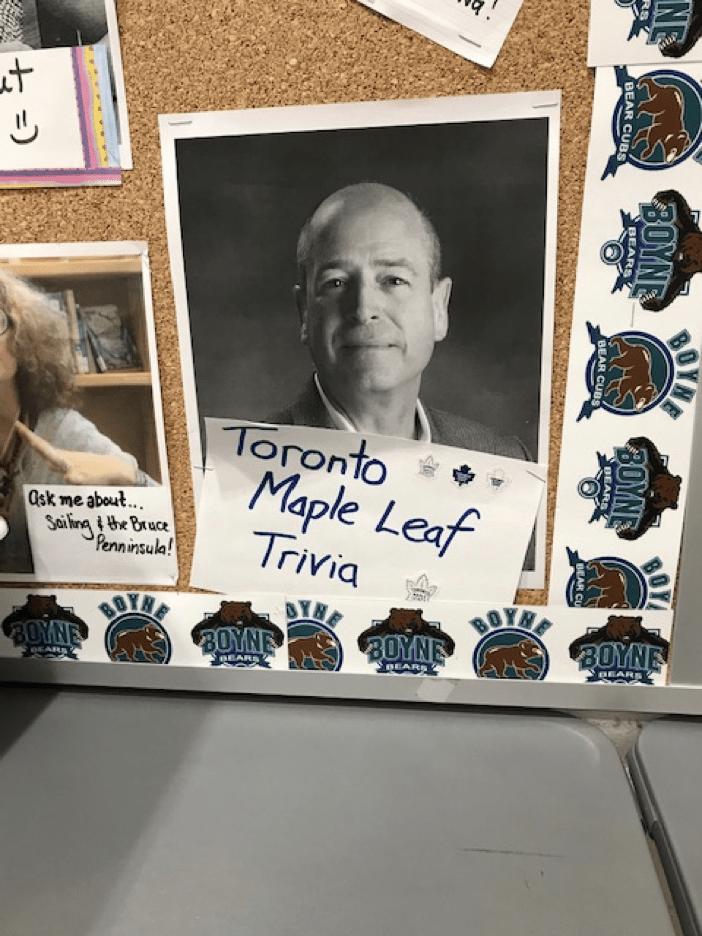
Ask staff to participate with you in an ‘Ask Me About…’ board.  We asked staff to provide a photograph and we gave an index card to each of them.  On the index card they would write a topic that they had an interest in, and/or knowledge about, that others might not realize they had this interest.  Some were very factual and detailed and others were put up for fun.  Across the top of the bulletin board in large letters we would write, ‘ASK ME ABOUT…” and then below would be the photographs of staff and the cards showing their interest. Staff would include travel destinations, gardening, sports etc.  Not only does it show another side of the staff and you can have some fun with it the students and staff can make connections with others.  The number of times that staff shared with me that students approached them and mentioned that they also had an interest in or love for their topic was numerous. You can also have great fun with the staff that sometimes are a little slow in handing things in!  I often made up staff interests, used a staff photo from our school files and put up my own pictures of staff.  They were very curious when students would come up to them and ask them about their knowledge of ‘animals that start with the letter ‘P’’ or ‘world’s best water slides’.  When complete you can see the great variety and talents of the adults in the building.  Families that come into the school could see another human side of the great people that care for their children and the positive climate we have in the building.  It is important for your parents to see that the adults in the school care and support each other and it is a positive place to work.

The second idea is a blank slate.  Provide a bulletin board that is empty and covered in paper so students, staff and families can post positive comments, affirmations, quotes etc.  If the heading on the top of the board is something like ‘Our Positive Comment Board’ and you have a few staff begin the process you will be surprised at the high quality of comments that you receive.  As a graffiti board you can encourage diagrams, and sketches as well.  Have staff introduce it to the students in their class and have them share the intent of the board.  It can change over the course of the year, during special events, to encourage sports’ teams, days of significance etc.  You will need to monitor the board and be prepared to attach paper over top of any section where inappropriate messages may appear.  In all honesty I have not had an issue with this idea as long as staff pre-teach the purpose behind it and students are well aware of the expectations.  Students loved walking by and seeing their work and the comments, sayings of their classmates.  Consider having a space for the students to leave their impressions for sharing.

And finally, a place for your community to leave their warm wishes and thoughts.  During open house we would have a graffiti board similar to the idea above just for parents.  We would write above the board something like, ‘What are your hopes for your child this year at school?’ Or ‘What opportunities would you like to see this year for your child?’ Or ‘How can we be the best school for your child?’  You get the idea.  This would be a place for parents to put down their thoughts and share for staff what they see in our school.  Another way to accomplish the same outcome is to send home with students a paper with a star or the school logo and ask students to assign to their parents the homework of putting their answers on the paper that is provided.  When the papers are returned they are tiled up on the board for staff to read the comments, and this way you can select and edit the comments you wish to post.  Another way to accomplish the same result is to post on Twitter, or send out a survey, blog and ask parents to respond to the question in some manner letting them know you are going to print out some of the responses and display them in the front hallway of the school with names, or no names depending on your views.  Some families signed their names on the board or on their paper and some did not, so if done electronically I would give them the option to have their name included or not.  In my experience the vast majority of the parent responses were in the category of being safe, having fun, feeling heard, belonging, having opportunities, making friends and not specific to areas of the curriculum.  Staff need to see this, it reinforces the time and energy we invest in the important work of relationships, equity, belonging and mental health.  As parents we do want the same things for our children. The knowledge that they are attending a school where the adults care for them, get to know them as individuals and see all their strengths, desires and assets. Let your community and staff see what others see as the vision for the school.

If you use any of these ideas during the course of the year I would love to see visuals.  Send me a photo, I’d love to see it in action once again.  

Come on back next week for more leadership interesting ideas!

Be well.

Awards

The idea of having ‘best of’ in elementary schools is particularly concerning to me at this stage in my career.  As we begin at Boyne Public School it is important to develop our view of awards, not just for graduation but awards throughout the school as well.   As the staff that begins our school we have the important task of developing a philosophy that we hope will last well into the future.  After having a School Directions meeting early in June and listening to those in attendance it is time to capture what some of you were saying and what I have been thinking for quite a while now.

I don’t want to come across as hypocritical, because in every school where I have taught and every school where I have been an administrator there has been school awards.  I have played a role in handing out honours awards after each reporting period, recognized excellence in Learning Skills, gave awards for attendance and have participated in close to thirty graduations where awards were presented at a special evening at the end of the year for students and families.  So while I write about what some schools do, keep in mind that those schools include locations where I was Principal.  Once established, traditions and ‘the way we do things around here’ are difficult to change.  This is why I believe here at Boyne Public School we have the opportunity to do better, to be different and create something that is more reflective of our beliefs and values.

I struggle with the ‘ranking and sorting’ of students based on academic achievement, athletic performance, artistic ability and concepts such as citizenship.  In each and every school I have been a part of discussions that create tensions, concerns and worries year after year.  The staff discussions go something like this: we start by handing out awards for academic achievement (honours, numbers of A’s and B’s on reports, highest mark) and find we have to add to the number of awards being offered because there is inherent discomfort in having ‘just academic awards’.  People understand that there is something wrong in having only awards for school marks because students are more than their report cards.  We teach the whole child. Why recognize academic achievement at all, if people agree that marks are meaningful but not the most important aspect of a student?  So they create additional awards that honour effort, or improvement.  This leads to more discussion. What will be the criteria to measure effort and/or improvement?  Schools end up with many awards, in many areas in order to cover all the bases.

With report card grades as awards, the adults in a school generally believe that all the academic areas should be recognized.  We would need to have an award for every subject area.  If you have an award for every academic subject you then get pushed into the discussion on whether there should be a male and female recipient for that award.  This can lead to a discussion about female students in STEM subject areas, males in the arts, and this does not even take into account our evolving understanding and acceptance of the term “gender” for awards.  What a mess?  This happens each and every year.

Leaving academics for a while, let’s discuss our Learning Skills.  In situations where staffs are asked to honour students with Learning Skills Awards I have witnessed two different scenarios.  In one, students receive a certificate, or an award of some kind based on the number of ‘G’s’ and ‘E’s’ on the report.  How do students and families feel when they are one area short of recognition?  Do teachers manufacture results in order to have students not miss out?  Shouldn’t an award be created because it is earned by student effort and hard work, not due to the sole judgment of the teacher when faced with the decision of who will receive recognition and who will miss out?  I have personally witnessed assemblies where all but 2-3 children, as young as grade one, from an entire class, would receive a Learning Skills certificate.  Something is broken in a process that would allow those children to feel what they must have felt.  In the second example of Learning Skills recognition, I have seen schools divide the Learning Skills into groups, in order to focus on a small select group of the skills, for example, three in a term.  At the end of a set time, usually monthly assemblies, students are recognized for the Learning Skill(s) being highlighted.  Since there are so many Learning Skills schools ensure that every child will receive some recognition during the school year for at least one of the Learning Skills.  What must teachers be thinking when they look at their class list and see the names of the students that have not received recognition and they are running out of Learning Skills to award?  It is the final Learning Skills assembly coming up and certain students have to have their turn, because it is the right thing to do, it is what is expected of me and understood in the school.  There may be numerous students that should receive recognition for the highlighted Learning Skill but it is not their turn, or they already did win an award at the previous assembly.  Based on Learning Skill criteria, some students should be awarded for every one of the Learning Skills. 

This argument does not even take into account the whole assessment and evaluation criteria used for grading Learning Skills!  Self-regulation looks different for different people. I know that I have been fortunate to work with amazing staff, who are kind and thoughtful people.  But I also know that teachers do not always evaluate Learning Skills as they were intended, which is giving students multiple opportunities to demonstrate, receive feedback and improve upon each and every Learning Skill, like we would for an academic expectation!!!  Across the grades, and across classrooms are we using the same criteria for the distribution of these kinds of awards? Do teachers use the same rigor and evidence for Learning Skills to determine a level of achievement as they do for the academic subjects?  It would seem to me that we should have pretty stringent criteria for the grades used for Learning Skills if we are going to go to all the time and trouble to award students for their achievement in those skills. We have students that achieve excellence in Learning Skills without ever having to give any thought or effort into receiving their level.  We have other students that are working extremely hard to improve their Learning Skills never to achieve the standard expected, and we have teachers who struggle with the assessment of Learning Skills.  Like academic achievement in subject areas, I think there has to be a better way.

Turning our attention to academic achievement, I have heard of schools that will set up a system that awards students for the number of ‘A’s’ or ‘B’s’ on their report.  Staff members will get together to develop a system.  Of course they want all the subject areas to be weighted equally, because they would not want to suggest to anyone that some subjects are more important than others!  Do students and families value the subject areas the same way?  Imagine how it would feel to win “musician of the year” (insert any other academic area)  in an environment where the arts is not held in the same regard as other subject areas on the report, by the adults in the school, the adults in the audience, or the students’ own peers? Someone may come up with a formula that incorporates the amount of time spent in subject area disciplines, because with so little time spent in drama/dance, although it is important for well-rounded students, it does not take up the number of minutes in a week that other ‘core’ subjects use.  I have heard these kinds of discussions in the past! 

Schools determine the number of ‘A’s’ required for ‘honour’s certification’ and then struggle with the students that fall just short.  They argue about the number of honour students in one class, or the grades in one class compared to others.  They grow concerned with the students that work incredibly hard and still do miss out on being able to achieve ‘A’s’.  They debate the concept of ‘A’ in our reporting system based on criterion referenced standards, which indicate that the provincial standard is a ‘B’.  They try to define what they all mean by Level 4 work.  Most importantly they struggle with how students feel when they rank and sort them based on their grades.  Someone in the group suggests that they should not be doing that to their students and families because there is an overemphasis on grades and performance, and the emphasis on grades begins too early in school.  Finally as a school they decide they will not award any student for academic achievement below a certain age because that is not what they are about.  It certainly doesn’t make sense in primary!  But how does it make sense in junior and intermediate then?

But then a school decides that for the graduation of their grade eights they will hand out medals.  Families, staff and students walk in the hallways of the school and see plaques indicating the names of the students in the past that have the highest graduating academic average in each subject area!  Or they see the award for the two students (cause you have to do male and female) that won the citizenship award, athlete of the year, musician of the year, dancer, artist, etc.  These awards hang near the front entrance of the school as a visual reminder, a first impression because as a school they are about academic achievement and indicating who the best is.  We could be a school where those plagues are hanging.  We could be a school that hands out the highest graduating mark award for all the subject areas, and have a time in the ceremony where we call out the names of our winners and they come to the stage to receive their award.  We could be that school!

The arguments against becoming a school like this and using numerical grades to rank and sort students are starting to gain momentum.  Yes, Universities and Colleges are still using grades for entry into programs.  But they are also increasingly looking at experiences, profiles, volunteer hours and other factors to determine who gains entry to their institutions.  They are not using grade eight marks!

Grade eight awards in some schools recognize one year of achievement or effort.  Is there a difference if a child has been at the school for 10 years and therefore the school could take credit for their impressive performance on the report card, or the child that has just come to the school in grade eight?  Who deserves the credit for the child’s impressive academic growth?  Was there academic growth? What if the best math student arrived the summer prior to grade eight? Considering the child has no control if they attend our school or the one down the street it seems like highlighting one year is incorrect, yet that is what some schools do. 

Don’t we want our students to achieve and be wonderful human beings, life-long learners, collaborative, curious, inquisitive and wonderful representatives of our school and beliefs?  Do awards support us in this direction?

 In secondary school is there a difference between a 78% and a 79%? (most likely you would not see a 79%, as a teacher would, out of compassion move the grade to an 80%)  Go ahead, try to convince me that there is a difference between a 72 % and a 75%!  This is why Elementary schools use a 15-16 point scale in grade 7 and 8.  Teachers should be assessing based on criteria against a norm.  Teachers then record grades based on Level 1,2,3,4 performance not a raw numerical score and then calculate an average.  We are past the days of determining an average from a mark book, yet on the report card we are still required to place a numerical value, hence the need for the point scale.  If we truly believe in highest, most consistent, most recent then we may have classes where many students perform at a Level 4 plus.  If Level 4 plus equates to 95%, because we need grades on a report card, who gets the science award when multiple students have done this?  In a large elementary school, with numerous graduating classes, does a 95% in one class equal a 95% in another?  Some subject areas may have one teacher for all the students, but many students will have different teachers for subjects in a grade eight home room model.  So now the debate begins, because my 95% students should get the award over your 95% students. Or, we give the award to 6,7,8 different students who all earned the 95%, all the names on the plaque, all get medals.  Or, worse, we pick one from the students that all achieved the same grade!!!!  Take any subject area in any primary or junior grade.  The highest grade possible is an A plus.  How many students could that be in a year?  Imagine taking all the grade four social studies A plus students and picking just one to win an award?  Yet, schools do it for a graduation award.

Change of direction here.  At graduation let’s have an award called, “Teacher of the Year”, also let’s do Educational Assistant of the year, and cap off the evening with Parent of the Year.  Sounds a little ridiculous, but how would that change the feel and mood of the graduation evening?  Every day you place your heart and soul in this school.  You put in so many extra hours while still committing time and energy to family, friends, outside interests etc (just like our students and their busy lives) You come every day and do a fabulous job, and ‘others’ get to decide who will receive this prestigious award.  In front of your peers, families and other staff we will bring a select few on stage to be recognized.  You are adults, you understand!  You will not feel slighted, or feel you are not appreciated.  Oh, and after not receiving the award, you leave the school and go to another school the following year, without the chance to be recognized the following year. You get one chance.  

We talk a lot about collaboration, how can we discuss community, inclusion, and acceptance and then provide individual awards?

The argument for giving out awards often sounds like this.  Our grade eights will understand.  Their families will understand.  That’s life!  And, life is hard. These are not my thoughts but I have heard it said, we are not preparing students for the world in which they currently live, we are preparing students for the world that is ahead of them.  In a very short time, we will have students leave us that have been here numerous, numerous years.  In a decade, we will have our first graduating class of our original Kindergartens.  They would have been with us for ten years.  Ten years is longer than they will be in any other institution of learning.  Ten years is longer than some of them will be in a career, before switching to another.  Ten years is longer than some of their future relationships.  We have a ten year relationship!!  Ten years they have heard ‘Work Hard, Be Nice, Make a Difference’ and on their special evening, when they say goodbye to us and we wish them well, we award some of them.  We have to do better.  We will do better.

While I knew we had the first year to really consider these kinds of decisions, I knew the time would come with a full group graduation in the second year.  I understood we would have a very special graduation in the first year with three students from our Life Skills class.  They were deserving of a celebration and we would not be setting any precedent because a graduation of three students would look different than a graduation of sixty students.  It was an example of ‘going slow in order to go fast’.  Once the decision is made to create awards, purchase plaques, and develop criteria for those awards your graduation ceremony and process is pretty well set for all those that come after you, with probably only minor changes.  And while it is impressive to visit a school and see the ‘Wall of Fame’, I question who it serves.  Do awards start to lose their luster for those that have achieved success early and often.  How many athletic awards does the athlete of the year have in their bedroom prior to winning the grade eight award and what does this recognition do to the self-esteem of the other students? Does it inspire the current students to Work Hard, Be Nice and Make a Difference in order to get their names on the wall?  Is there a better way to motivate and inspire?  What impact does a child’s background, families, socioeconomics, home environment and current teachers have on the winners of awards?

There is currently lots of debate about intrinsic and extrinsic rewards within the research.  Providing a prize versus the internal drive of doing the right thing is a key debate at this time. The work of Alfie Kohn, The Risk of Rewards tells us that when safe, inclusive learning environments are provided rewards and punishments are unnecessary and are actually destructive to children.  Daniel Pink’s, Drive shares lots of research about motivation and the detrimental impact of rewards on critical thinking.  He believes that award ceremonies are for the adults, not the students.  Would Carol Dweck’s work on Mindsets see awards for achievement as fostering a fixed or growth mindset?  John Hattie’s Visible Learning, confirms these beliefs.  Tangible rewards undermine motivation, engagement and regulation. Imagine how those students, who understand early in the year that they will not receive an achievement award, look forward to their ending school months and graduation?  They know who the winners will be!

For those fortunate enough to witness our Life Skills graduation this past year you would have been extremely happy and proud about how the school was represented and the message we gave families and students about what the adults in the building believe and do.  Our students were proud, our students were happy, and our students were recognized for their accomplishments.  None of them received an award.  They all were given a moment in the spotlight and no family member or child left that day believing that some students were more talented, blessed or more loved.  This is what graduation should be.  This is the message that should be received about Boyne Public School and the people within its walls.  How can every graduating student leave our school proud, loved and ready for the next stage in their education?

We have a school mantra.  Tom Hierck’s new book, Starting a Movement explains

Develop a mantra that captures the essence of your school’s mission in a concise

and repeatable way…A mantra is a statement repeated frequently to aid in

concentration of thought. In Sanskrit, mantra literally mean ‘instrument of

thought’.  It can be a short, energy-infused statement around which your

school organizes, it defines what you are and guides all internal decisions.

Further, it’s a powerful chant that everyone inside your school can instantly

Understand, recognize, and repeat-a constant reminder of what you can expect

from each other. (p.62)

Work Hard, Be Nice and Make a Difference.  If we examine the work we do with this lens, because that is why a mission statement is created, do we really live it if we rank and sort students and provide awards for a few?  When we created our common expectations for classrooms, hallways, outside, at assemblies etc using the slogan Work Hard, Be Nice and Make a Difference we asked ourselves what it would look like and sound like if students and adults were doing those things.  If we included awards, recognitions and graduation as a topic, and created how this looks using Work Hard, Be Nice and Make a Difference, do you believe we would come up with the current practice that is happening in many schools, or as a staff would we create something different.  And just not for the sake of creating something different, but because we know something just isn’t right about it, it doesn’t reflect our mission statement and we have the chance, right now at the beginning of our school to do something about it.

I am not advocating that we are lowering our standards or that every student gets some top award but I do have a suggestion that aligns our beliefs with what I think should be our practice going forward.  If we honour all student achievement during the year, and continually share with families how our students work hard, show they are nice and make a difference and also provide opportunities for students to shine in front of peers and families, do we still need a singular event at the end of the year to recognize a few? Instead of a yearend assembly to recognize a few students from each class why not end the year the way the year begins?  We work hard during ‘Significant 72’ to build community, inclusion and safety.  The ideas behind ‘Significant 72’ mean we continue to connect with our classes 72 minutes a month and individual students 72 seconds every day.  Each class at the end of the year holds a celebration in their final ‘Significant 72’ where each student is recognized.  Each student at Boyne PS leaves for the school year with a beautiful certificate and a story to tell.

I ask you to think of a student you worked with last year.  Now consider our school mantra of ‘Work Hard, Be Nice, Make a Difference’.  To which of these three statements do you most associate with this student?  Do they have a high academic standing because they ‘Work Hard’?  Are they kind, each and every day, to every student in your class, so ‘Be Nice’ comes to mind?  Were they a part of a club, or group in our school that made the lives of someone better and therefore ‘Make a Difference’ is their banner?  When I asked the same question to some of you during a School Directions’ Meeting this past year two things happened.  Each adult at the table was able to tell a lengthy story about a student and they told the story while their face lit up, so proud of the student they were describing.  When we did a second round of storytelling, this time with a student that requires a bit more love and care, they were still able to connect how hard they had worked, how much they have improved, how they show up each day with a smile on their face ready to learn.  Even our hardest to serve students can be seen to Work Hard, Be Nice and Make a Difference during the course of the year.  Every student can be recognized within our mantra.

At the end of next school year, I imagine some classes getting together in grade teams.  I can see the presentation of certificates being recorded so students can share with their families at home.  I can see staff writing out a paragraph on the child and sending it home with the certificate so families can share in the moment.  The possibilities are endless, but the bottom line remains the same.  If we learn about our students’ DNA (desires, needs, assets) and work during the year on the aspects of our School Effectiveness Plan (S.E.F. 2.5) that we say we are going to highlight, mainly promoting and sustaining student well-being and positive student behavior in a safe, accepting, inclusive and healthy learning environment then we will not be at a loss on how to recognize each and every student.  And, we don’t need individual awards at a year-end assembly.  Students begin the year in the comfort of their home room format and end the year the same way.  We still have a year-end assembly to say goodbye, laugh, sing and dance but it is community building not individual promoting.

Grade 8 Graduation runs the same way.  Each and every student has accomplished the same goal, the completion of their elementary schooling.  We often ask parents to hold their applause until all the students in a class are introduced, we even did that in Kindergarten this year (yes, come to think about it we didn’t give any individual awards in Kindergarten!  So again, why do we give them in grade eight?).  We ask parents to hold applause because we don’t want to take anything away from any other student.  We don’t want a student to walk across the stage and receive a huge round of applause to have the next student walk across in silence, but later in the evening schools provide individual awards????  How about all students have their story told.  Each individual can walk across the stage and the audience can hear what they did to show that they ‘Work Hard’ (maybe it is the highest grade in music?), or that they are ‘Nice’ or ‘Make a Difference’.  Is one any more important than the other? 

We have designed some beautiful certificates that can be individualized to indicate which part of the school mantra is being used and some lines for us to write in the reason why it is presented.  We will work on the details, but I am definitely leaning toward recognizing the accomplishments of all students in a manner that maintains positive feelings about themselves, and their views of the school. 

Will some think this is too nice?  Yes, there will be criticism about how there is now a shift to “everyone gets a trophy”!   Given the choice, I would much rather have a student or parent ‘or staff’ question why we do not have awards, than have hurt, angry, sad students and families on the final days of their elementary  school  career because they did not receive an award.  If we are going to stay on course with “work hard, be nice, make a difference” and frame all we do around this statement we have to align our beliefs.  If we have spent years working with students with this saying in order to have each believe that every single one of them is important, I do not see how providing individual awards is consistent with this. WE have the chance to do something better?  Don’t you agree?